








By Ayomide Otitoju
There is mounting unrest among civil servants in Ogun State following the decision of the State Civil Service Commission (CSC) to rescind the approval earlier granted by Governor Dapo Abiodun for the lateral transfer of staff from the Executive cadre to the Officer cadre, in line with the National Council on Establishments (NCE) guidelines.
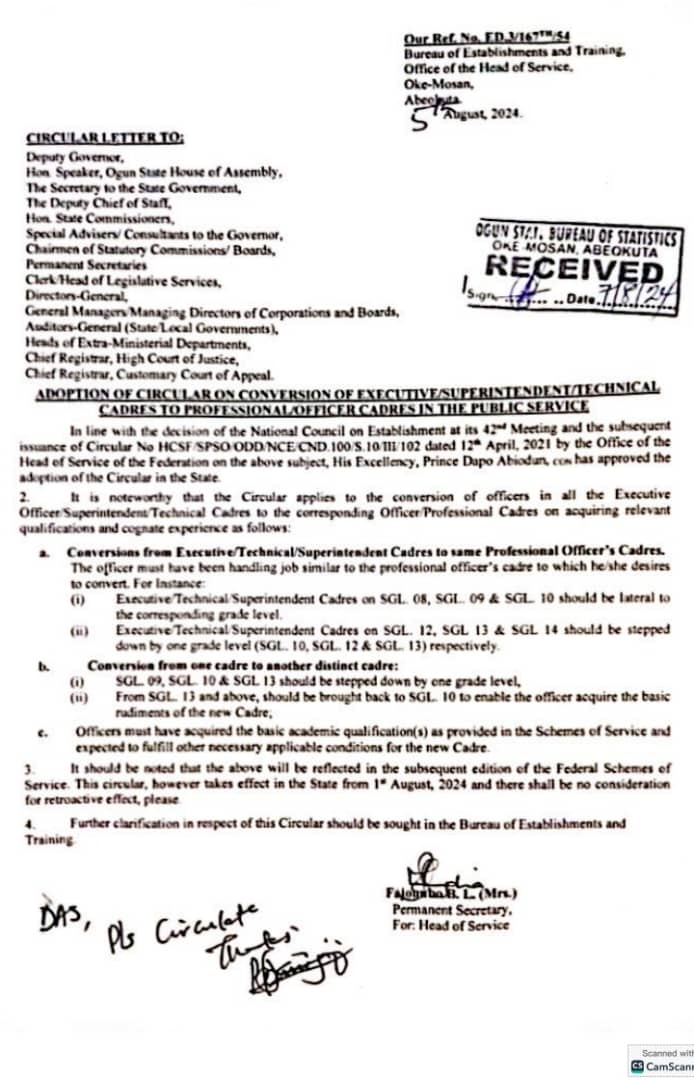
According to a circular issued by the Bureau of Establishments and Training on August 5, 2024, titled “Adoption of Circular on Conversion of Executive/Superintendent/Technical Cadres to Professional/Officer Cadre in the Public Service,” eligible Executive Officers on Grade Levels 14, 13, and 12 seeking conversion within the same Ministries, Departments, and Agencies (MDAs) were to be placed one grade level below, while those on Grade Levels 10, 09, and 08 would retain their current grade levels without financial benefits.
The circular, which took effect from August 1, 2024, emphasized that applicants must possess the requisite academic qualifications as stipulated in the scheme of service. Acting on this directive, the CSC invited qualified workers to apply for the conversion exercise.
However, widespread dissatisfaction has erupted following the release of the final list of successful candidates, which many civil servants claim contradicts both the Governor’s approval and the NCE’s established guidelines. Several affected officers alleged that instead of implementing the approved policy, the CSC “upturned” the directive by placing many officers on lower grade levels. Reports indicate that some workers were demoted from Grade Level 14 to 10, 12 to 9, and 10 to 8—contrary to the provisions of the circular and practices in other states.
While officers in some MDAs, such as the Ministries of Environment and Health, were reportedly placed correctly, others were allegedly downgraded by one or more levels, sparking concerns about inconsistency and fairness in the process.
The aggrieved officers have appealed to Governor Abiodun—renowned for his pro-labour disposition—to intervene and correct what they described as an “unjust and demoralizing” decision by the Commission.
Meanwhile, stakeholders in the state’s civil service have urged the government to conduct a transparent review of the exercise, stressing the importance of due process, equity, and the protection of career advancement rights for affected officers.