


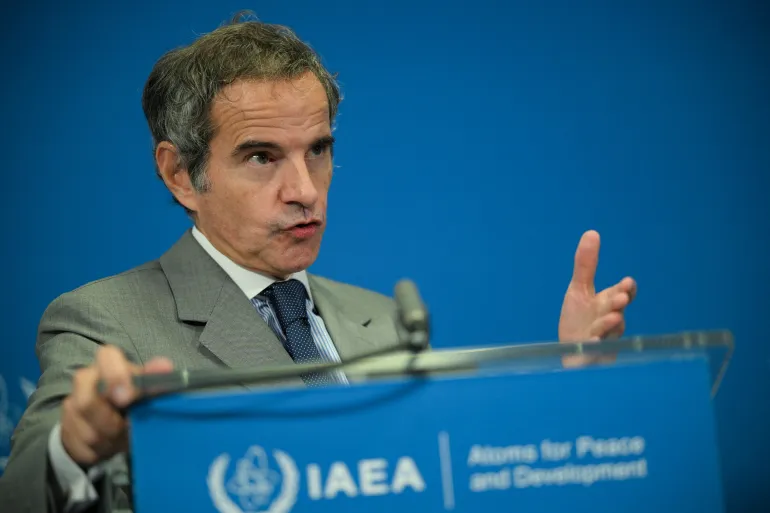
The head of the United Nations’ nuclear watchdog has said Iran’s pledge not to develop nuclear weapons will require “very strong” international verification as Tehran and Washington negotiate a permanent agreement aimed at ending their months-long conflict.
Speaking on Friday, Director General of the International Atomic Energy Agency (IAEA), Rafael Grossi, said Iran had repeatedly stated it had no intention of pursuing nuclear weapons, but stressed that such assurances must be backed by rigorous inspections.
“I think the objective of this agreement is to ensure that there is no development of nuclear weapons in Iran. The government of Iran has declared quite clearly that this is not their intention,” Grossi said.
“But of course intentions are not enough. We have to have a very strong verification system in place as soon as is practicable,” he added.
Iran’s nuclear programme remains one of the major issues in ongoing negotiations with the United States following a preliminary agreement signed last week to end the conflict that erupted in February after a large-scale US-Israeli military campaign against Iran.
Grossi said the IAEA had only “barely initiated” discussions with Iranian officials since the agreement but expected talks to accelerate in the coming days.
Under the preliminary deal, Iran’s stockpile of highly enriched uranium is to be diluted under IAEA supervision. Before the conflict, the agency estimated that Iran possessed about 440 kilograms of uranium enriched to 60 per cent, although the current status of the material remains uncertain after US and Israeli strikes targeted Iranian nuclear facilities last year.
“Initial conversations have taken place,” Grossi said. “We expect this work to pick up soon.”
Iran has consistently maintained that its nuclear programme is intended solely for peaceful civilian purposes, rejecting long-standing accusations by Western governments that it is seeking to build a nuclear weapon.
US President Donald Trump said earlier this week that Iran had agreed to allow UN inspectors to return to its nuclear facilities, while Grossi also indicated that inspections were expected to resume.
Iran suspended cooperation with the IAEA last year following US and Israeli attacks on its nuclear infrastructure.
Grossi noted that, besides diluting Iran’s enriched uranium stockpile, exporting the material out of the country remained another technical option under consideration.
Meanwhile, tensions persist over the Strait of Hormuz, another major issue in negotiations between Washington and Tehran.
The strategic waterway, which links the Gulf to the Arabian Sea, remains a critical route for global energy exports. Iran temporarily closed the strait during the conflict in retaliation for US-Israeli military strikes and has since proposed imposing transit fees on vessels using the route.
The proposal has drawn strong opposition from the United States and Gulf states.
US Secretary of State Marco Rubio, speaking during a visit to the Gulf, warned that such charges would create “total chaos,” stressing that while Washington seeks a lasting agreement with Tehran, it would not accept one “at any price.”
Security concerns also remain high in the waterway. On Wednesday, an attack on a commercial vessel forced the United Nations to suspend efforts to evacuate stranded seafarers. The United Kingdom Maritime Trade Operations (UKMTO) agency reported that a cargo ship sustained damage after being struck by an unidentified projectile, although no casualties were recorded.
Despite signs of diplomatic progress, many Iranians say they have yet to experience any improvement in their daily lives.
“Overall, nothing has improved,” said Amir, a 28-year-old government employee. “Life has simply become more difficult.”
Another resident, Mehdi, a 35-year-old content creator, said meaningful progress would only be measured when ordinary citizens begin to feel the economic benefits.
“Until such changes are felt in people’s everyday lives, it is only natural that hope will remain accompanied by doubt, and that anticipation will give way to exhaustion and anxiety,” he said.


