







By Ayomide Otitoju
For many Nigerian businesses, opportunities for growth increasingly lie beyond the country’s borders as companies seek new suppliers, customers and investment opportunities across Africa.
The expansion of intra-African trade is being supported by the African Continental Free Trade Area (AfCFTA), which provides a framework for greater economic integration and market access. Farmers, traders, cooperatives, commodity aggregators and small businesses are also turning to digital platforms to connect with regional markets.
However, cross-border payments remain a major challenge for businesses, with traditional payment channels often involving foreign currency requirements, intermediary banks, multiple currency conversions, additional costs and lengthy processing times.
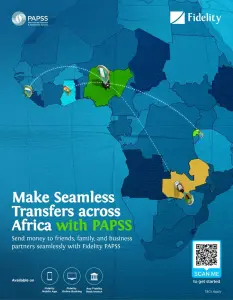
The Pan-African Payment and Settlement System (PAPSS) is designed to address some of these challenges by enabling secure and near-instant payments between participating African countries.
Under the system, an eligible Nigerian customer can initiate a payment in naira while the beneficiary receives the equivalent value in the applicable local currency.
The model reduces the need to source US dollars or euros for eligible intra-African transactions and limits reliance on multiple currency conversions and correspondent banks outside the continent.
For Nigerian businesses, this can simplify payments, speed up settlement and improve visibility over transaction costs.
Through Fidelity Bank Plc, eligible PAPSS transfers can be completed in about 120 seconds, subject to applicable requirements and the receiving market. The faster settlement can help businesses meet supplier payment deadlines, protect delivery schedules and improve cash-flow management.
PAPSS also supports eligible personal and commercial transactions, including payments to suppliers, distributors and service providers, school-related payments and approved family support across participating African markets.
For businesses engaged in regional trade, faster payments can improve cash-flow predictability, strengthen supplier relationships and support operational planning. Manufacturers can settle eligible invoices more efficiently, while retailers and exporters can reduce some of the challenges associated with foreign currency sourcing and cross-border transactions.
Fidelity Bank offers PAPSS services through its mobile app, online banking platform and branch network. Customers can also obtain assistance from Relationship Managers or visit branches for information on applicable documentation and transaction requirements.
The bank onboarded PAPSS in September 2024 and recorded more than N46 billion in transactions during its early adoption phase before the platform’s official launch in August 2025.
According to the bank, PAPSS identified Fidelity Bank as one of the first Nigerian banks to meet the relevant integration requirements.
The lender has since expanded access to the service through its digital channels and branches, allowing customers to initiate eligible transactions digitally or receive assistance in person.
Security and compliance checks form part of the PAPSS payment process, with customers required to provide accurate beneficiary details, transaction purposes and supporting documentation where applicable.
PAPSS is currently live in 19 African countries and connects more than 160 commercial banks and over 15 national payment switches, according to TechCabal.
The growing adoption of the system reflects the increasing need for payment infrastructure capable of supporting expanding intra-African commerce.
Fidelity Bank said its early adoption of PAPSS, transaction experience, digital banking platforms and branch network position it to support Nigerian individuals and businesses seeking to make eligible cross-border payments across Africa.
As regional trade expands, efficient payment systems such as PAPSS are expected to play a greater role in helping businesses secure supplies, strengthen partnerships and access new markets.