




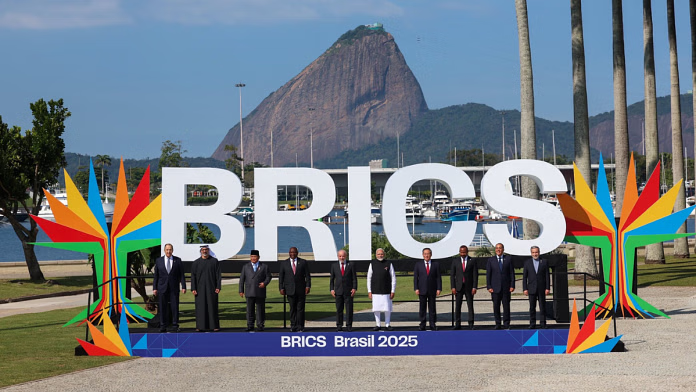
Leaders of the BRICS bloc—comprising Brazil, Russia, India, China, South Africa, and six other emerging economies—used their summit on Sunday to issue a pointed rebuke of what they described as “indiscriminate” unilateral tariffs and recent US-Israeli military strikes on Iran, signaling deepening tensions with Washington.
Although the joint communiqué avoided naming US President Donald Trump directly, the bloc expressed “serious concerns about the rise of unilateral tariff measures,” warning they pose a significant threat to global economic stability. The criticism comes as Trump’s administration threatens punitive duties on countries aligning with BRICS positions. In a post on his Truth Social platform, Trump vowed to impose an additional 10% tariff on any country “aligning themselves with the anti-American policies of BRICS.”
The summit also marked a show of solidarity with Iran, which formally joined BRICS in 2023. The bloc condemned recent military strikes targeting Iran’s nuclear and military infrastructure—widely attributed to the United States and Israel—labeling them a violation of international norms.
Despite internal differences, particularly over Middle East policy, BRICS nations called for an “immediate” ceasefire in the Gaza Strip and the full withdrawal of Israeli forces, aligning with growing global calls for a resolution to the 21-month conflict between Israel and Hamas.
The language of the summit declaration reflected attempts to balance diverging interests among members. Notably, Iran, which maintains a hardline stance against Israel, reportedly voiced reservations over the bloc’s endorsement of a two-state solution to the Israeli-Palestinian conflict. However, Tehran ultimately refrained from rejecting the declaration outright.
The summit’s political weight was diminished by the absence of Chinese President Xi Jinping—marking the first time he has skipped the annual gathering in over a decade—and Russian President Vladimir Putin, who participated remotely due to an outstanding international warrant.
Meanwhile, Saudi Arabia’s foreign minister, whose country is a recent BRICS entrant and a major US defense partner, was absent from Sunday’s talks—another sign of internal diplomatic sensitivity within the expanded group.
Beyond geopolitical issues, the BRICS declaration also addressed emerging global challenges, calling for equitable regulation of artificial intelligence. The leaders stressed that AI development must not remain the exclusive domain of wealthy nations and urged inclusive governance frameworks to guide its use.
Originally formed as a forum for the world’s fastest-growing economies, BRICS is increasingly positioning itself as a counterweight to US and Western dominance. However, the bloc’s expansion and diverging national agendas continue to challenge its ability to present a unified front on key global issues.


