




By Ayomide Otitoju
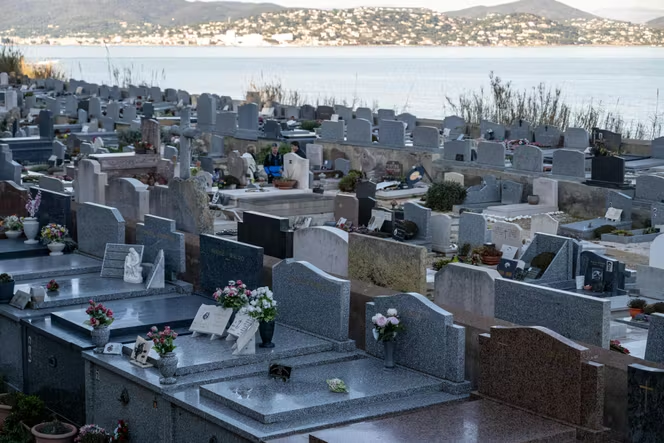
French cinema icon Brigitte Bardot will be buried in a cemetery in her hometown of Saint-Tropez, local officials said on Monday, as France debates how to honour a cultural figure whose legacy is marked by both artistic influence and political controversy.
Bardot, who died on Sunday at the age of 91, had previously expressed a wish to be buried in the garden of her home under a simple wooden cross, similar to those marking the graves of her pets. In a 2018 interview with Le Monde, she said she preferred that option to burial in the town cemetery, fearing crowds could disturb her family’s graves.
However, an official at the Saint-Tropez town hall confirmed that plans are in place for her burial at the town’s seaside cemetery, though no funeral date has been announced.
Bardot rose to international fame in her early twenties with her role in the 1956 film And God Created Woman and went on to star in around 50 films. She retired from acting in 1973 to focus on animal rights advocacy, a cause she pursued for decades through her foundation.
In later years, Bardot became a polarising figure due to her outspoken far-right views. She was convicted five times for hate speech, largely related to comments about Muslims and residents of France’s overseas territory of Réunion.
She died in the early hours of Sunday with her husband, Bernard d’Ormale, a former adviser linked to the far right, at her side. A representative of her animal welfare foundation said she passed away peacefully after whispering a final message of love to him.
Tributes poured in from across the political spectrum, though reactions were divided. President Emmanuel Macron described Bardot as a “legend” of 20th-century cinema who embodied freedom, while far-right leader Marine Le Pen hailed her as “incredibly French” and praised her independence. Bardot had publicly supported Le Pen in the 2012 and 2017 presidential elections.
Calls for a national tribute similar to that accorded to late rock star Johnny Hallyday were met with opposition from left-wing figures. Socialist Party leader Olivier Faure said national honours should be reserved for those who upheld republican values, noting Bardot’s repeated convictions for racism despite her cinematic achievements.
Communist Party leader Fabien Roussel acknowledged her role in elevating French cinema globally, while Green lawmaker Sandrine Rousseau criticised what she described as contradictions between Bardot’s animal rights activism and her views on human rights issues.
Born in Paris on September 28, 1934, Bardot was raised in a traditional Catholic family. She was married four times and had one son, Nicolas-Jacques Charrier, with her second husband, actor Jacques Charrier. After leaving the film industry, she retreated to Saint-Tropez, dedicating her life to animal welfare.
Reflecting on her life in a 2024 interview ahead of her 90th birthday, Bardot said her early fame had enabled her to defend animals, calling it “the only cause that truly matters” to her.


