






By Ayomide Otitoju
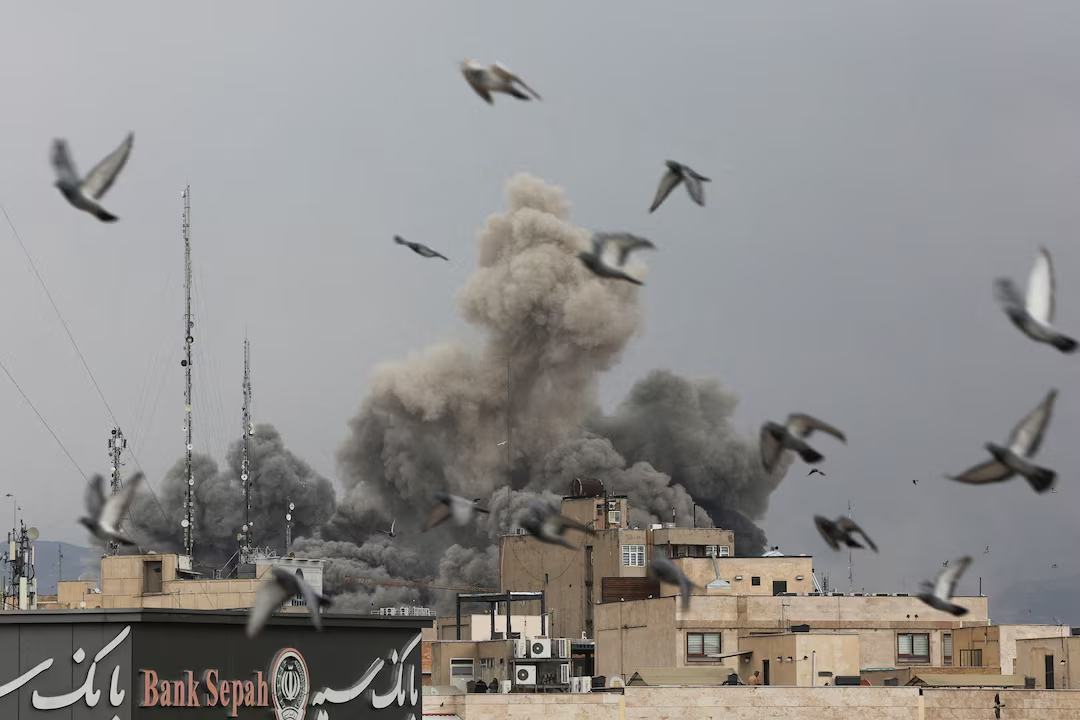
Israel launched fresh airstrikes on Lebanon early Thursday and said it intercepted missiles fired from Iran, as a widening conflict involving United States forces triggered escalating tensions across the Middle East, including new turmoil in Iraq.
A pre-dawn airstrike hit a suburb of Beirut, a stronghold of Hezbollah, the Iran-backed militant group that has vowed to avenge the death of Iran’s supreme leader, Ali Khamenei, in the opening moments of the conflict last Saturday. Israeli authorities said residents had been warned to evacuate before the strike.
Israel also reported intercepting a new wave of missiles launched by Iran, despite earlier claims by the United States that it had severely weakened Tehran’s military capabilities.
Iran has pledged retaliation for the attacks and has launched missiles across the region. On Wednesday, its elite Islamic Revolutionary Guard Corps claimed it had closed the Strait of Hormuz, a vital global shipping route through which about one-fifth of the world’s crude oil passes.
“The Americans’ mischief and deceit could lead to the collapse of the entire military and economic infrastructure of the region,” Iran’s military command warned in a statement.
Energy market intelligence firm Kpler reported that oil tanker transits through the Strait of Hormuz had dropped by about 90 percent amid the escalating crisis. Britain’s maritime agency also reported a large early-morning explosion near Kuwait, with oil spilling into Gulf waters.
Meanwhile, Iraq experienced a nationwide power outage on Thursday, though authorities said it was unclear whether the blackout was linked to the conflict. The Iraqi electricity ministry attributed the disruption to a sudden drop in gas supplies to a major power plant.
Iran also carried out a strike Wednesday in the autonomous Kurdish region of northern Iraq, killing a member of an exiled Iranian Kurdish group, according to a representative of the organization. The attack came amid reports that the United States was considering arming Kurdish guerrillas to infiltrate Iran.
“Separatist groups should not think that a breeze has blown and try to take action,” said Ali Larijani, secretary of Iran’s Supreme National Security Council. “We will not tolerate them in any way.”
The United States said one of its submarines sank an Iranian warship off the coast of Sri Lanka, marking the first torpedoing of a vessel by the U.S. since World War II. The vessel, the IRIS Dena frigate, had reportedly been on a friendly visit to India before the attack.
U.S. Defence Secretary Pete Hegseth said the ship “thought it was safe in international waters,” describing the strike as a “quiet death” and insisting that the United States was “fighting to win.”
Sri Lankan officials said at least 87 people were killed in the attack, with 61 still missing. Vijitha Herath, the country’s foreign minister, said 32 sailors were rescued, many of them wounded.
Iran’s state-run Islamic Republic News Agency reported that 1,045 military personnel and civilians had been killed since the war began, though the figures could not be independently verified.
Iran also said more than 150 people, many of them children, died in a strike on a school in the southern town of Minab, with state television showing large crowds mourning victims wrapped in white shrouds.
In another development, a missile launched from Iran was destroyed by a NATO air defence system while heading toward Turkey’s airspace. Turkish authorities said the missile had been aimed at a British military base in Cyprus but veered off course.
Hakan Fidan, Turkey’s foreign minister, later spoke by phone with Iranian Foreign Minister Abbas Araghchi, warning that steps that could expand the conflict should be avoided.
Iranian strikes have also raised alarm across Gulf states. United Arab Emirates, Saudi Arabia, and Qatar reported intercepting Iranian missiles on Wednesday, including a drone targeting Saudi Arabia’s Ras Tanura Refinery.
In Kuwait, the health ministry confirmed the death of an 11-year-old girl after she was struck by falling shrapnel. Across the Gulf, at least 13 people — including seven civilians — have been killed since the conflict began, while air travel across the region has been heavily disrupted.
The United States said it had dispatched its first charter flight to evacuate American citizens from the region, following similar efforts by France and United Kingdom.
In Lebanon, where Hezbollah entered the conflict by launching rockets into Israel, authorities said Israeli strikes have killed 75 people and displaced more than 83,000 since the latest round of fighting began.
Israel also warned residents to evacuate areas south of the Litani River, saying the military was “compelled to take action.” Airstrikes also hit a hotel in Hazmieh, marking the first reported attack in the predominantly Christian suburb of Beirut near the presidential palace and several foreign embassies.
The strikes revived memories of past Israeli occupations of southern Lebanon. Video footage from the area showed what appeared to be Israeli tanks operating near residential buildings in Khiam, roughly six kilometres inside Lebanese territory.
Meanwhile, Emmanuel Macron, President of France, urged restraint during a phone call with Israeli Prime Minister Benjamin Netanyahu, warning against a ground offensive and calling on Israel to preserve Lebanon’s territorial integrity.
Macron also spoke with Lebanese leaders, urging them to pressure Hezbollah to halt its attacks.
Iran’s military has warned that Israeli embassies worldwide could become targets if Israel attacks Tehran’s diplomatic mission in Lebanon.


