




By Ayomide Otitoju
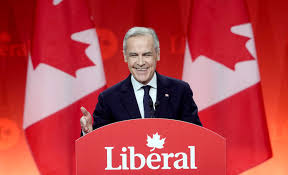
Mark Carney was officially sworn in as Canada’s 24th prime minister on Friday, assuming leadership at a time of escalating trade tensions with the United States following President Donald Trump’s return to office.
The ruling Liberal Party overwhelmingly backed Carney to replace outgoing Prime Minister Justin Trudeau, banking on his expertise as a former central bank governor to navigate a looming economic crisis.
“We’re going to get right to work,” Carney told reporters ahead of his swearing-in ceremony. His first cabinet meeting is scheduled immediately afterward, and diplomatic sources confirmed his first foreign trip as prime minister will be to Europe next week.
Carney, who turns 60 on Sunday, is a political newcomer who has never held elected office. However, his leadership skills will be quickly tested, with Canada likely heading toward a general election in the coming weeks—an election expected to be dominated by tensions with Washington.
Trump’s Tariffs and Canada’s Response
Since returning to the White House, Trump has imposed sweeping tariffs on Canadian imports and suggested that Canada is “not viable” as an independent nation. He has even hinted at annexing the country—a stance Carney has called the most serious threat Canada has faced in a generation.
“Everything in my life has prepared me for this moment,” Carney said after securing the Liberal leadership. A former Goldman Sachs investment banker, he served as governor of the Bank of Canada during the 2008 financial crisis and later led the Bank of England through Brexit turmoil.
His new cabinet, trimmed from Trudeau’s 36 ministers to 23, retains key figures handling U.S. relations, including François-Philippe Champagne in finance, Dominic LeBlanc in trade, and Bill Blair in defense.
Speaking at a G7 meeting in Quebec, Foreign Minister Mélanie Joly said Carney’s leadership would bring a “new dynamic” to diplomatic relations. She and U.S. Secretary of State Marco Rubio are working to arrange a call between Carney and Trump in the coming days.
Election Looms as Political Landscape Shifts
Trump’s tariffs and rhetoric have significantly altered Canada’s political landscape. At the start of the year, Trudeau’s Liberals trailed the Conservatives by 20 points in the polls. However, since Trudeau announced his resignation on January 6, the race has narrowed considerably.
“Carney is arriving at a good time. He has emerged as a figure people seem to trust to take on Donald Trump,” said Felix Mathieu, a political science professor at the University of Winnipeg.
Carney has made efforts to distinguish himself from Trudeau, adopting a more centrist stance. While maintaining climate action as a priority, he has scrapped Trudeau’s individual carbon tax in favor of market-based solutions. He also rejected a capital gains tax on the wealthiest Canadians, arguing that “builders should be incentivized for taking risks and rewarded when they succeed.”
Carney’s first challenge will be managing Canada’s trade crisis with its largest trading partner. Visiting a steel plant in Hamilton this week, he vowed to work toward a deal with the U.S. but insisted that “respect for Canadian sovereignty” must be upheld.
With an election on the horizon, Carney now faces the test of proving that his economic expertise can translate into political success.


