




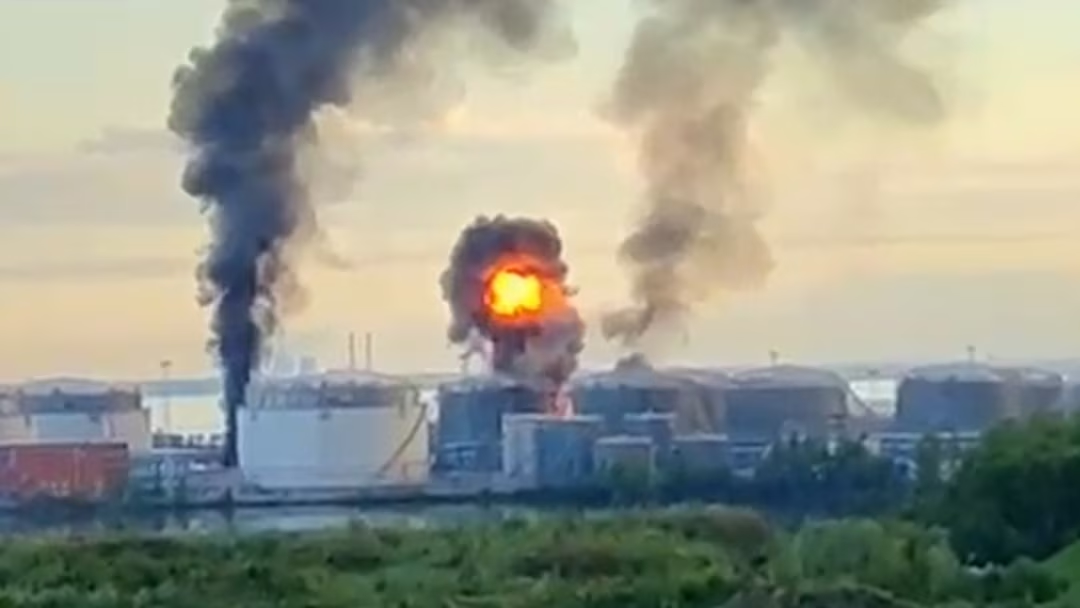
Ukrainian drones struck energy and military facilities in Russia’s Saint Petersburg early Wednesday, according to Russian and Ukrainian officials, as the city prepared to host its flagship economic forum attended by thousands of international delegates.
The attack came as approximately 20,000 participants from 130 countries gathered for the three-day Saint Petersburg International Economic Forum (SPIEF), often referred to as “Russia’s Davos,” which opened on Wednesday.
Saint Petersburg Governor Alexander Beglov said several infrastructure facilities were damaged in the drone assault, although no casualties were reported. The Kremlin vowed to respond to the attack, which followed a wave of Russian missile and drone strikes across Ukraine a day earlier that reportedly killed 23 people.
Ukrainian President Volodymyr Zelensky said the drones targeted the Saint Petersburg Oil Terminal and the Kronstadt military base, describing the operation as part of Kyiv’s strategy of “long-range sanctions” against Russian military and energy infrastructure.
“Ukraine’s plan for long-range sanctions is being implemented exactly as needed to bring peace closer,” Zelensky said in a social media post accompanied by footage showing a burning oil facility.
Ukraine’s drone forces commander also claimed that a Russian warship was hit at the Kronstadt naval base, releasing footage purportedly showing the strike.
Ukrainian officials said the operation was intended to disrupt SPIEF, where Russian President Vladimir Putin is expected to deliver a keynote address on Friday.
“The Petersburg forum is opening with a nice plume of black smoke in the background after Ukrainian strikes,” said Sergiy Sternenko, an adviser to Ukraine’s defence minister.
An AFP reporter at the forum venue observed smoke visible in the distance as delegates arrived for the opening sessions. Flight operations were also affected, with several services between Moscow and Saint Petersburg delayed.
Once regarded as Russia’s premier platform for attracting Western investment, SPIEF has increasingly reflected Moscow’s geopolitical isolation since the launch of its full-scale invasion of Ukraine in February 2022.
While previous editions featured leaders such as French President Emmanuel Macron, former German Chancellor Angela Merkel and late Japanese Prime Minister Shinzo Abe, this year’s forum is being attended largely by officials from Russia’s allied and partner nations, including Uzbekistan, Tanzania, Belarus, Cuba, Saudi Arabia and the United Arab Emirates.
Kirill Dmitriev, the Kremlin’s economic envoy, described the gathering as a forum for “sovereign countries,” contrasting it with what he termed “globalist” events such as the World Economic Forum in Davos.
“The countries of the Global South are building up their economic strength, actively moving toward partnership with Russia and will be strongly represented,” Dmitriev said.
United Nations Secretary-General Antonio Guterres is scheduled to participate in an environmental panel on Friday, while the United States delegation includes Rodney Mims Cook Jr., head of the US Commission of Fine Arts, who is expected to speak on cultural relations between Russia and the United States.
Meanwhile, fighting continued on the battlefield. Russian-installed authorities in occupied eastern Ukraine said seven people were killed when a Ukrainian drone struck a bus travelling between Moscow and Crimea.
Russia’s Defence Ministry reported that its air defence systems intercepted 354 Ukrainian drones overnight across several regions, including Crimea and territories bordering Ukraine.
In Ukraine, local officials said Russian attacks killed four civilians on Wednesday, including two in the southern city of Kherson and two in the northeastern Kharkiv region.
The latest exchanges underscore the escalating drone warfare between the two countries, with Kyiv intensifying strikes on Russian military and energy targets in response to sustained Russian attacks on Ukrainian cities.


