









By Ayomide Otitoju
Economist Paul Alaje has stated that while the recent inflation rebasing by the National Bureau of Statistics (NBS) may boost investor confidence, it does not alter the economic hardships faced by Nigerians, particularly high food prices.
Speaking on Politics Today on Channels Television, Alaje noted that prior to the rebasing, food inflation stood at 51.8%. However, under the new methodology, food inflation now accounts for only 40% of total inflation.
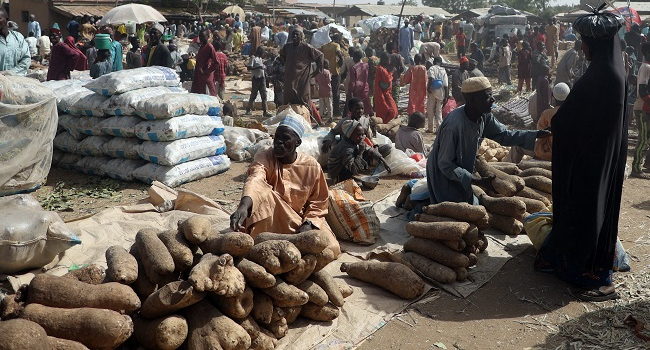
“That does not mean that if you go to the market tomorrow, food prices will improve. That would be misleading—our economic reality remains unchanged,” he said.
Alaje acknowledged that the revised figures might encourage investment by presenting a lower inflation rate but stressed that the fundamentals of the economy remain the same.
The NBS announced the rebasing of the Consumer Price Index (CPI) on Tuesday, shifting the reference year from 2009 to 2024. As a result, Nigeria’s headline inflation rate reportedly changed from 34.80% in December 2024 to 24.48% in January 2025.
However, Alaje cautioned against misinterpreting the data, emphasizing that inflation had not truly declined but had been recalculated based on a new base year.
“It would be wrong to say inflation dropped from 34% to 24%. If inflation had truly fallen, we would see a corresponding drop in prices, which is not the case,” he explained.
He insisted that the correct terminology was a “change” in inflation methodology rather than a “drop” in inflation itself.
Alaje also pointed out broader economic adjustments, such as the government’s shift in employment measurement from 20 hours per week in 2009 to one hour per week in the present framework. He referenced key policy decisions—including subsidy removal and forex rate floatation—as critical factors requiring further economic adjustments.
During his 2025 budget presentation last December, President Bola Tinubu projected a decline in Nigeria’s inflation rate to 15% by year-end. However, Alaje and fellow economist Bismarck Rewane described this target as aspirational and unrealistic.


