







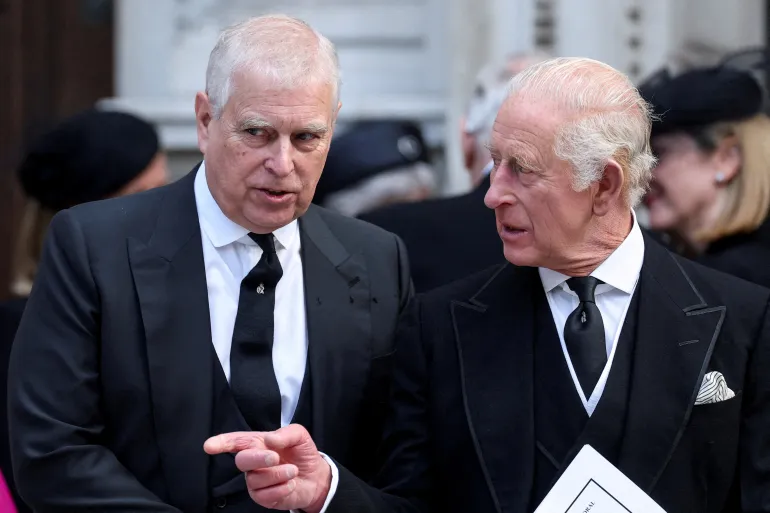
King Charles III’s unprecedented decision to strip his younger brother, Prince Andrew, of his royal titles has drawn widespread approval across Britain but reignited calls for deeper accountability and reform within the monarchy.
The King’s move—marking the first time since 1919 that a royal has been formally deprived of a princely title—comes amid renewed controversy over Andrew’s ties to convicted US sex offender Jeffrey Epstein.
In a statement released Thursday, Charles also confirmed that Andrew, 65, would be removed from his residence on the Windsor Castle estate. The decision followed fresh allegations from Virginia Giuffre, one of Epstein’s principal accusers, whose posthumous memoir detailed claims that she was trafficked to have sex with Andrew three times, including twice as a minor.
Public reaction has been largely supportive. “Maybe he should have done it a long time ago, but well done for doing it now,” said Pam Williams, an American living in Britain since 1972. The Daily Mirror hailed the move with the headline “Finally!”, while The Sun quipped, “The Andrew formerly known as Prince.”
Prime Minister Keir Starmer’s office confirmed that the government “fully supports the decision,” adding that the Palace consulted Downing Street beforehand.
Despite the widespread praise, some believe the action falls short. Sky Roberts, Giuffre’s brother, told the BBC, “It’s not enough… he needs to be behind bars.” Anti-monarchy group Republic has reportedly instructed lawyers to examine whether there is enough evidence to pursue a private prosecution against Andrew.
While the Metropolitan Police previously dropped their investigation into Giuffre’s claims in 2021, biographer Andrew Lownie said there is now “renewed vigour for them to look at this properly.”
Prince Andrew, who has consistently denied the allegations, reached a multimillion-dollar settlement with Giuffre in 2022 to resolve her civil sexual assault lawsuit.
Royal analysts say the scandal marks one of the monarchy’s most serious crises in decades. Historian Ed Owens described it as “a genuinely historic moment,” comparing it to the aftermath of Princess Diana’s death and the 1936 abdication of Edward VIII.
Owens added that Charles’s decisive step reflects the royal family’s growing struggle with transparency, noting, “What we’ve seen is a crisis involving one individual snowball into a much bigger crisis about a lack of openness.”
Andrew, now known simply as Andrew Mountbatten-Windsor, will retain his position as eighth in line to the throne. He is expected to relocate to a private lodge on the King’s Sandringham estate in eastern England, with moving arrangements funded personally by Charles.
Close associates say the King hopes the move will allow the monarchy to move forward. “He’ll be feeling a measure of relief and hope that, for him and for the monarchy, it will now go away,” said broadcaster Jonathan Dimbleby. “Although it won’t, of course, for Andrew.”


