






The UN Security Council on Monday adopted a U.S.-drafted resolution backing former U.S. President Donald Trump’s Gaza peace plan, approving the deployment of an international stabilization force and outlining a pathway toward a future Palestinian state. The resolution passed with 13 votes in favor, while Russia and China abstained but did not exercise their veto power.
Trump hailed the vote on social media as “one of the biggest approvals in the History of the United Nations,” claiming it would pave the way for “further Peace all over the World.”
U.S. Ambassador to the UN Mike Waltz said the decision marked “another significant step” toward stabilizing Gaza and ensuring Israel’s long-term security.
Hamas Rejects Resolution
Hamas, which is barred from any governing role under the resolution, rejected the plan, saying it failed to address Palestinians’ “political and humanitarian demands and rights.”
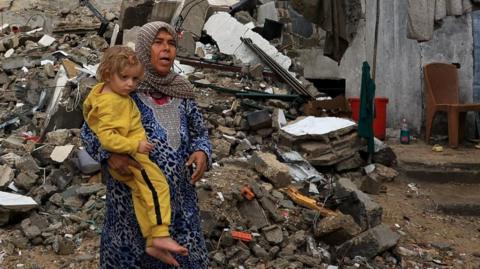
The U.S.-backed text, revised repeatedly during intense negotiations, endorses Trump’s plan, which has helped maintain a fragile ceasefire in Gaza since October 10. The territory has been devastated by two years of conflict following Hamas’s October 7, 2023 attack on Israel.
International Force, Transitional Governing Body Approved
The resolution authorizes the creation of an International Stabilization Force (ISF), tasked with working alongside Israel, Egypt and newly trained Palestinian police to secure border areas, demilitarize Gaza, decommission weapons held by non-state armed groups, protect civilians, and secure humanitarian corridors.
It also approves the formation of a “Board of Peace,” a transitional governing body for Gaza to be chaired by Trump, with a mandate through 2027.
The document contains indirect language about the prospect of Palestinian statehood, stating that once the Palestinian Authority enacts reforms and reconstruction progresses, “conditions may finally be in place for a credible pathway to Palestinian self-determination and statehood.” Israel has firmly rejected that possibility.
Humanitarian Aid and International Support
The resolution calls for the large-scale delivery of humanitarian assistance through the UN, the International Committee of the Red Cross, and the Red Crescent, urging the opening of all crossings to ensure relief agencies can operate freely.
“We must substantially step up our work to support the UN humanitarian effort,” said British Ambassador James Kariuki.
Israeli Ambassador Danny Danon argued the plan would ensure Hamas “will not pose a threat against Israel anymore.”
Russia Pushes Alternative Draft
Russia circulated a rival draft criticizing the U.S. text for failing to adequately endorse a two-state solution. The Russian proposal called for explicit reaffirmation of the Council’s commitment to Palestinian statehood, while avoiding authorization of an international force or the Board of Peace until the Secretary-General provided further options.
Moscow’s UN envoy Vasily Nebenzya accused Washington of rushing the process, saying members “were not given the time to do the work in good faith.”
Despite Russia’s objections, the U.S. secured support from several Arab and Muslim-majority nations, including Qatar, Egypt, the UAE, Saudi Arabia, Indonesia, Pakistan, Jordan, and Turkey, who issued a joint statement backing the resolution.


