







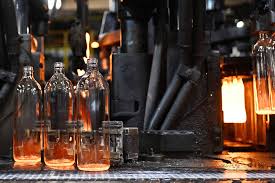
Molten glass pours through chutes before being moulded into bottles at the northwest England plant of manufacturer Encirc, where soaring energy costs are piling pressure on Britain’s heavy industry.
Oliver Harry, head of corporate affairs at Encirc — which produces more than a third of the UK’s glass bottles — said the company is grappling with energy bills far higher than those faced by European competitors.
“We’re paying a lot more energy costs than our European competitors,” he said, warning that the price disparity is undermining competitiveness.
Britain recorded the highest industrial electricity prices in Europe in 2024, according to the latest government data. Analysts attribute the surge to the country’s reliance on natural gas and the costs associated with transitioning to renewable energy, both of which are reflected in consumer and industrial bills.
At the Elton factory, where two massive furnaces operate at intense heat, Harry said rising costs are already driving customers to seek cheaper imports from countries such as China and Turkey. He cautioned that some of these suppliers operate with lower environmental standards.
Energy-intensive sectors — including steel, chemicals, cement and glass — have repeatedly warned that existing government support measures are insufficient to safeguard competitiveness.
The government recently announced it would raise discounts on electricity network charges to 90 percent from April, a move expected to save around 500 major energy users a combined £420 million annually. A government spokesperson said lowering energy bills remains central to policy decisions.
However, industry groups argue that more robust measures are needed. Gareth Stace, director general of UK Steel, said industrial power prices remain nearly 40 percent higher than in France and Germany. He called for stronger protections similar to schemes in France, Italy, Spain and the United Arab Emirates.
Experts say the UK’s pricing structure compounds the problem. Under the liberalised electricity market, the last power station brought online to meet demand sets the wholesale price. In Britain, this is often a gas-fired plant.
“In France, nuclear sets the price fairly often and nuclear is cheaper, so it’s not always the same expensive gas that sets the price,” said Sam Fankhauser, professor of economics and climate change policy at the University of Oxford.
Gregor Singer, professor at the London School of Economics, noted that while the UK successfully reduced emissions by phasing out coal, the timing of the 2022 gas price shock following Russia’s invasion of Ukraine has slowed the transition benefits.
“It’s unfortunate that this gas price shock came just as coal exited and before renewables were fully scaled up,” Singer said, adding that in the medium to long term, increased renewable capacity should ease electricity prices.
Despite the pressure, Encirc says it remains committed to decarbonisation. Harry stated that by the end of the decade, the company aims to produce glass bottles with an 80 percent reduction in carbon emissions, underscoring the industry’s effort to balance sustainability goals with economic realities.