








By Ayomide Otitoju
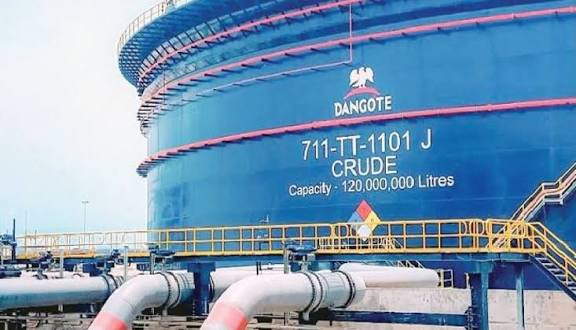
The Dangote Petroleum Refinery has said it remains fully exposed to international commodity markets, including crude oil prices, freight charges, insurance, and financing costs, despite Nigeria’s crude-for-naira policy aimed at supporting local refineries.
Speaking at a press briefing on Monday, Managing Director and CEO David Bird explained that while the policy allows refineries to buy crude in local currency, pricing remains tied to global benchmarks, meaning the refinery still purchases Nigerian crude at market rates without discounts.
Bird noted the impact of global volatility on operations, citing a sharp rise in crude prices from the mid-$60 range to nearly $120 per barrel within a week. Shipping costs have also surged, with tanker freight for a single shipment climbing from about $800,000 to $3.5 million in the current market environment.
Despite these cost pressures, the refinery continues to operate at its full capacity of 650,000 barrels per day, with potential to increase output to around 700,000 barrels per day.
Fuel Price Revision
In response to market pressures, the refinery revised ex-depot prices, raising Premium Motor Spirit (PMS) to ₦1,175 per litre and Automotive Gas Oil (AGO) to ₦1,620 per litre. This marks the fourth consecutive price adjustment in under two weeks, according to Petroleumprice.ng, reflecting the continued upward trend in domestic fuel costs.
The petrol price jumped from ₦995 per litre, while diesel rose from ₦1,430 per litre, coinciding with a sharp increase in international crude benchmarks as of 1:00 pm WAT: Brent Crude $102.8 (+10.91%) and WTI Crude $101.0 (+11.08%), amid escalating geopolitical tensions in the Middle East.
Global Market Turbulence
The surge in global energy prices is tied to conflict involving the United States, Israel, and Iran, which has disrupted energy flows and global commerce. Shipping through the Strait of Hormuz, a corridor carrying roughly one-fifth of global oil shipments, has slowed due to security threats, driving up shipping and insurance costs.
Several energy facilities in the Gulf region have reportedly halted operations over safety concerns, tightening supply and further contributing to volatility in international energy markets.
The developments underscore the continued influence of geopolitical tensions on global energy trade and highlight the challenges faced by refineries like Dangote in navigating international market pressures.