







By Ayomide Otitoju
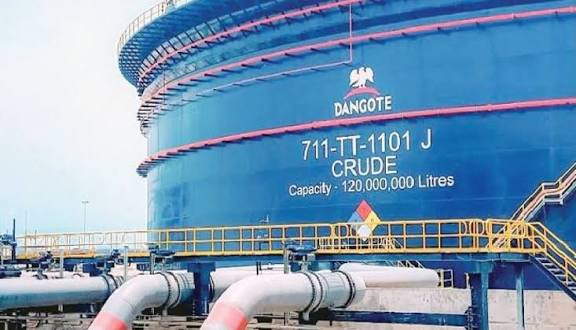
The Dangote Petroleum Refinery has emerged as the world’s largest single exporter of aviation fuel in April 2026, capitalising on supply disruptions caused by the conflict in the Middle East that have reshaped global refined petroleum product markets.
According to a report by S&P Global, the milestone follows the refinery’s attainment of full operational capacity in February, enabling it to respond rapidly to increased global demand for aviation fuel.
Data from S&P Global Commodities at Sea showed that the 650,000-barrel-per-day refinery shifted into what industry observers described as “max jet mode” after the outbreak of hostilities in the Middle East, significantly increasing jet fuel production to fill supply gaps in international markets.
Chief Executive Officer of Dangote Petroleum Refinery, David Bird, told Platts that the facility’s operational flexibility has positioned it as a major global refining hub while strengthening Nigeria’s role in international petroleum products trade.
“Within weeks of reaching full capacity, we were able to increase aviation fuel production and help address shortages created by the conflict,” Bird said.
S&P Global noted that the refinery can currently process up to 40 different crude oil grades and plans to expand that capability to more than 100. To support future growth, the refinery is diversifying its crude sourcing strategy beyond Nigeria to include supplies from Africa, the Middle East, the United States and other producing regions.
Bird described the refinery as a fully merchant refining operation, unlike conventional refineries tied to a single crude source.
“This is not a traditional refinery in an oil-producing country that just sits at the end of a crude pipeline and processes one crude. This is a fully merchant refining model similar to what you would see in Europe or Asia,” he said.
The refinery is also increasing petrol production through the importation of blending components such as gas-to-liquids (GTL) naphtha and Bonny condensate. According to Bird, the facility can comfortably produce 75 million litres of petrol daily and could raise output to 100 million litres per day with additional storage infrastructure.
S&P Global further disclosed that Dangote Refinery is pursuing several expansion projects, including a linear alkylbenzene plant, a diesel hydrotreater and a proposed 750,000-metric-tonne-per-year propane dehydrogenation facility that will convert imported liquefied petroleum gas into polypropylene.
The report highlighted that a planned $10 billion expansion project would increase the refinery’s processing capacity to 1.4 million barrels per day, equivalent to about 90 per cent of Nigeria’s current crude oil production.
To support the expanded capacity, the refinery intends to broaden its crude slate by incorporating heavier grades and residues while increasing crude imports from international markets.
Bird noted that the refinery currently exports about half of its output and plans to direct all additional production from future expansions to export markets.
The company is also moving away from a predominantly spot-market sales model towards longer-term supply agreements with governments, national oil companies and major distributors.
“We want to build direct offtake relationships and ensure we are not simply the supplier of last resort,” Bird said.
He added that the refinery has received growing interest from several African countries and recently concluded a supply arrangement with Ethiopian Airlines.
To strengthen its export logistics, Dangote Refinery is expanding its marine infrastructure through the construction of a four-berth jetty designed to accommodate medium-range tanker vessels, reducing dependence on road transportation and improving cargo handling efficiency.
Industry analysts say the refinery’s growing export footprint underscores its increasing influence in global energy markets and its potential to position Nigeria as a major exporter of refined petroleum products.