






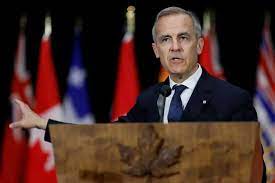
Canada’s newly appointed Prime Minister, Mark Carney, has called for early parliamentary elections on April 28, pledging to counter U.S. President Donald Trump’s escalating trade and sovereignty threats.
Carney, a former central banker, was chosen by the ruling Liberal Party to replace Justin Trudeau but has yet to face a national vote. He accelerated the election timeline from October to April, framing the campaign as a battle against Trump’s aggressive stance toward Canada.
“I’ve just requested that the governor general dissolve parliament and call an election for April 28. She has agreed,” Carney said in a national address, referring to King Charles III’s representative in Canada.
Carney Rallies Against Trump’s Influence
Carney is seeking a fresh mandate as he positions himself as Canada’s defender against Trump’s repeated dismissal of Canada’s borders and calls for the country to become the 51st U.S. state.
“We are facing the most significant crisis of our lifetimes because of President Trump’s unjustified trade actions and his threats to our sovereignty,” Carney declared.
Carney vowed not to meet with Trump until the U.S. president recognizes Canada’s sovereignty, emphasizing the need to strengthen the economy and national security.
Trump’s administration has imposed punitive tariffs on Canadian imports, threatening severe economic consequences. His comments dismissing Canada’s borders as “artificial” have outraged Canadian leaders and fueled nationalistic sentiment.
Election Becomes a Referendum on Trump
Traditionally, Canadian elections focus on domestic concerns like the cost of living and immigration. However, this election is shaping up as a referendum on Trump, with voters divided on how best to respond to his policies.
Until recently, the Conservative Party, led by Pierre Poilievre, was favored to win, capitalizing on dissatisfaction with Trudeau’s leadership. However, Carney’s ascension has dramatically shifted the race, making it too close to call.
“This is an existential election, unprecedented,” said Felix Mathieu, a political scientist at the University of Winnipeg.
Poilievre, 45, a seasoned politician, is seen as a tough-talking populist. On Sunday, he distanced himself from Trump, declaring: “I want the opposite of what Donald Trump wants.” He pledged to focus his campaign on economic concerns rather than foreign policy battles.
Meanwhile, smaller opposition parties could see their support dwindle as Canadians rally behind either Carney or Poilievre to fortify Canada’s position against Trump.
Trump’s Dismissive Response
Despite the high stakes, Trump has brushed off concerns about Canada’s election.
“I don’t care who wins up there,” he said this week. “But just a little while ago, before I got involved and totally changed the election—which I don’t care about—the Conservative was leading by 35 points.”
With Trump set to announce new tariffs on April 2, the election will likely center on who can best defend Canada’s interests in an era of heightened U.S.-Canada tensions.


