






By Ayomide Otitoju
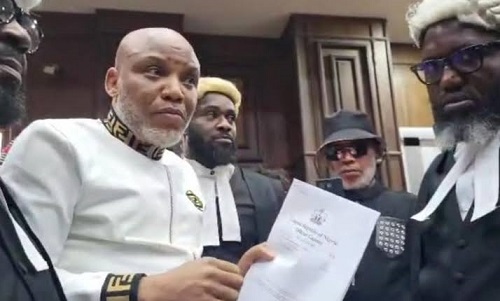
The Federal High Court in Abuja has admitted the medical report and death certificate of former presidential aide, Ahmed Gulak, as evidence in the ongoing terrorism trial of Nnamdi Kanu, leader of the proscribed Indigenous People of Biafra (IPOB).
Justice James Omotoso admitted the documents on Tuesday after the defence, led by Senior Advocates of Nigeria Kanu Agabi, Chukwuma-Machukwu Ume, and Aloy Ejimakor, raised no objections to their submission by the prosecution.
The prosecution, led by Adegboyega Awomolo (SAN), also submitted a police report from Owerri, Imo State, linking Gulak’s killing to gunmen suspected to be IPOB members. The documents were presented through a witness identified only as BBB.
During cross-examination, Agabi challenged the credibility of a video recording of Kanu’s interrogation while in the custody of the Department of State Services (DSS), questioning the absence of DSS operatives in the footage. The witness responded that the recording was complete, as per standard procedure, but admitted he could not recall whether he was masked during the session.
The witness clarified that he served solely as an investigator and was not responsible for Kanu’s detention or well-being. He denied knowledge of any solitary confinement practices by the DSS and stated he was unaware of Kanu’s psychological condition, adding that such matters were beyond his investigative scope.
Further scrutiny revealed the witness was not involved in preparing the charges against Kanu and could not confirm dates related to the repeated amendments of the charge sheet. He also confirmed that Kanu had not been confronted with any of his accusers, noting that he merely delivered a directive from the Attorney-General of the Federation (AGF) to initiate the investigation.
Agabi highlighted that the AGF’s directive came after the charges had already been filed, suggesting irregularity in procedure. The witness, however, insisted he was unaware of when the charges were initially filed and acted only on official instructions.
The defence also informed the court of delays in obtaining critical police documents necessary for their case. While Awomolo opposed any adjournment, citing the court’s directive for an expedited trial, Justice Omotoso allowed a short adjournment.
“This matter has both international and domestic relevance,” the judge said. “I am inclined to grant an adjournment to ensure the defence is fully heard. Use this opportunity judiciously; the court seeks justice.”
The judge also addressed concerns about reports that Kanu’s legal team had been denied access to him by the DSS. While Agabi denied such claims, Justice Omotoso expressed concern over conflicting posts on social media, particularly one by Ejimakor, and cautioned against unprofessional conduct.


