








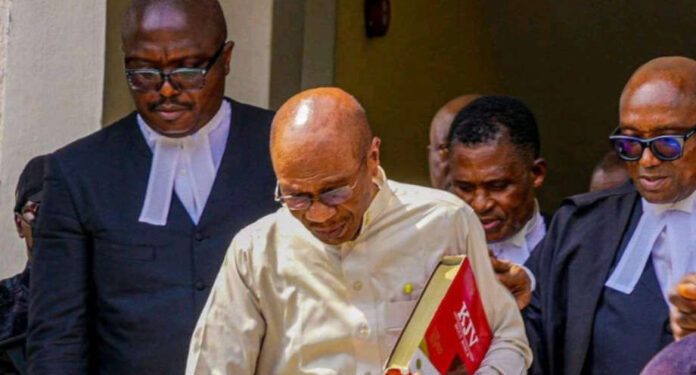
By Ayomide Otitoju
The Economic and Financial Crimes Commission (EFCC) has called on Justice Rahman Oshodi of the Lagos State Special Offences Court in Ikeja to dismiss an application filed by former Central Bank of Nigeria (CBN) Governor, Godwin Emefiele, challenging the court’s jurisdiction to hear his case.
Represented by Senior Advocate of Nigeria (SAN), Rotimi Oyedepo, the EFCC described Emefiele’s application as a delay tactic aimed at derailing the prosecution’s efforts to pursue economic and financial crimes.
Oyedepo argued that the Lagos State High Court has full jurisdiction to hear and determine the charges against Emefiele, contrary to claims by the former CBN governor’s lawyer, Olalekan Ojo (SAN).
Jurisdiction Dispute
Emefiele’s legal team contends that the court lacks the authority to hear the charges against him. Ojo argued that the allegations of abuse of office fall outside the purview of state high courts, raising significant constitutional and legal questions.
He also claimed that four of the 26 charges filed by the EFCC are unconstitutional, as they are not grounded in any existing Nigerian laws. Ojo further asserted that the court cannot adjudicate on offences related to the defendant’s tenure as CBN Governor.
Consequently, Ojo urged the court to strike out the charges for lack of jurisdiction.
EFCC’s Counterarguments
Responding to the application, Oyedepo maintained that the allegations against Emefiele constitute economic and financial crimes, which the EFCC is legally empowered to prosecute. He emphasized that Lagos State is the proper venue for the trial, as the alleged offences occurred within its jurisdiction.
Oyedepo urged the court to dismiss Emefiele’s application for lack of merit and assume jurisdiction to proceed with the trial.
Ruling Date Set
After hearing submissions from both parties, Justice Oshodi scheduled January 7, 2025, for his ruling on the application.
Background
The EFCC arraigned Godwin Emefiele alongside Herry Omoile on a 26-count charge, including allegations of accepting gratification, corruption, fraudulent property acquisition, and conferring undue advantage on associates.
The charges, filed under the Corrupt Practices Act 2000, are part of broader investigations into Emefiele’s tenure as CBN Governor. The case has drawn widespread attention as the EFCC seeks to prosecute alleged financial misconduct.