





By Ayomide Otitoju
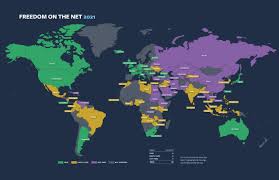
Global internet freedom has fallen for the 15th consecutive year, with notable declines recorded in both the United States and Germany, according to a new report released Thursday by Freedom House, a Washington-based democracy research organisation.
The 2025 edition of the Freedom on the Net report found that Western democracies are increasingly adopting restrictive online measures once associated with authoritarian regimes. The report cited worsening repression in authoritarian and authoritarian-leaning states, alongside new limitations emerging in democratic societies.
“We find worsening repression in authoritarian and authoritarian-leaning states, largely because governments in those countries see restrictions on the internet and online expression as a means of maintaining power,” said Kian Vesteinsson, the report’s co-author. “But in 2025, we’ve also seen conditions in democracies decline.”
He noted a growing trend in North America and Western Europe of “closing civic space” and “deepening restrictions on people posting hateful or problematic content.”
The United States scored 73 out of 100 in the latest assessment — its lowest rating to date and a three-point drop from the previous year. The report partly attributed the decline to the Trump administration’s detention of several non-U.S. citizens over online speech. Secretary of State Marco Rubio has also vowed to deport individuals for remarks about Israel, a policy currently facing court challenges.
Germany’s score also fell by three points to 74, reflecting increased self-censorship and aggressive enforcement of hate speech and defamation laws. Freedom House highlighted the case of a far-right website editor who received a suspended jail sentence and fine for posting a manipulated image criticising a politician.
While the Trump administration has accused Germany of stifling free expression, German officials maintain that strict speech laws are essential given the country’s Nazi history.
Outside the West, the steepest declines were recorded in Kenya, which temporarily shut down internet access during mass protests, as well as Venezuela and Georgia. Serbia was downgraded from “free” to “partly free,” while Nicaragua dropped to “not free.”
In contrast, Bangladesh registered the largest improvement following the formation of a new government that eased online restrictions after a student-led uprising.
Founded during World War II to promote democratic values, Freedom House has historically relied on U.S. government funding but operates independently. The report noted that funding cuts under President Trump’s renewed administration have forced the organisation to reduce staff and scale back some of its activities.