



By Ayomide Otitoju
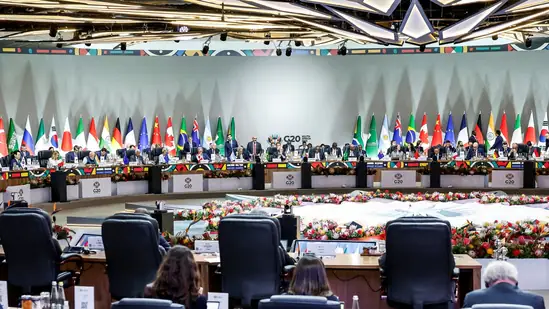
G20 leaders closed their summit in South Africa on Sunday with renewed pledges to uphold multilateral cooperation, even as widening geopolitical rifts, unilateral US policies, and ongoing conflicts strained efforts to find common ground.
Canadian Prime Minister Mark Carney warned that global politics had entered “a rupture,” cautioning against the rise of protectionism and geopolitical blocs. The summit, notably boycotted by the United States, focused heavily on whether the G20 can adapt to an increasingly fragmented world order.
South African President Cyril Ramaphosa said the meeting came “at a crucial time,” adding that the leaders’ joint declaration underscored their belief that shared goals outweigh national differences. The summit — the first hosted on African soil — drew leaders from Europe, China, India, Japan, Brazil, Turkey, and Australia.
The communique described the gathering as taking place against “rising geopolitical and geo-economic competition and instability, heightened conflicts and wars, deepening inequality, increasing global uncertainty and fragmentation.”
French President Emmanuel Macron cautioned on Saturday that the G20 may be “coming to the end of a cycle,” suggesting the bloc focus primarily on strategic economic coordination.
The United States refused to attend, arguing that South Africa’s emphasis on trade cooperation and climate action conflicted with Washington’s current positions. The US is scheduled to host next year’s summit, which President Donald Trump plans to hold at one of his Florida golf resorts.
Several leaders, including Carney, Ramaphosa and Brazilian President Luiz Inácio Lula da Silva, highlighted the growing influence of emerging economies and the Global South within the G20. Lula said recent global forums showed that multilateralism “is more alive than ever,” despite US ambivalence.
German Chancellor Friedrich Merz described America’s absence as “not a good decision,” but noted that the summit demonstrated the global system was “reorganising itself” as new alliances and partnerships emerge.


