







By Ayomide Otitoju
A Lagos State Government initiative is transforming spoiled fruits into clean energy and organic fertiliser at the Ikosi Fruit Market in Ketu, reducing waste, lowering business costs and improving livelihoods for traders.
The Ikosi Fruit Market Biodigester Plant, developed by the Lagos State Government in partnership with C40 Cities and supported by UK International Development, converts fruit waste into biogas that powers market lighting, food vendors and small businesses, while the by-product is processed into organic fertiliser.
For traders, the project has brought economic and environmental benefits by improving security, reducing operating costs and creating a cleaner market environment.
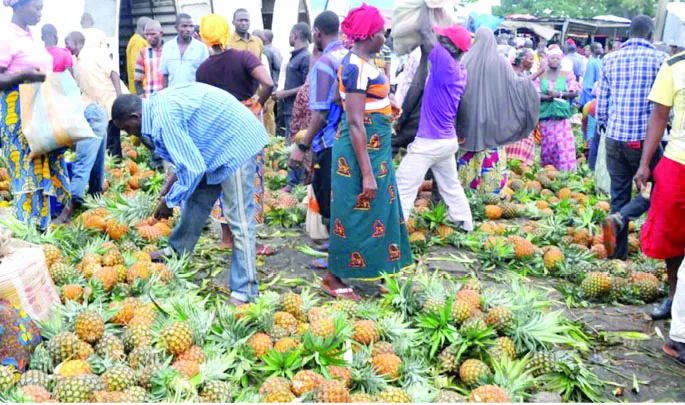
Mrs. Adebisi Olaitan, a pineapple trader with more than two decades of experience, said the initiative has transformed business activities in the market.
She explained that many of the pineapples sold at the market are transported from Benin, with some already spoiled before arrival in Lagos. Previously, unsold fruits were discarded, creating environmental and sanitation challenges.
Olaitan said the installation of market lighting powered by renewable energy has improved security, allowing traders to remain open later and encouraging more customers to visit the market.
She, however, appealed to the government to make cooking gas more affordable for traders.
Plant Manager, Engr. Fagbemi Oladele, described the facility as a practical demonstration of converting waste into wealth.
According to him, spoiled pineapples and watermelons are collected, washed, shredded and processed through anaerobic digestion to produce methane gas, which is purified and distributed for cooking, electricity generation and phone charging services within the market.
Oladele said the facility currently provides its services free of charge and operates with eight workers, while production depends on the volume of fruit waste collected daily.
System Engineer Samuel Ogebule explained that the shredded fruit mixture is pumped into four biodigesters, where naturally occurring microorganisms break down the waste in the absence of oxygen to generate biogas.
He said automated sensors regulate temperature and continuously mix the material to optimise gas production before purification and distribution.
Watermelon trader Adebimpe Halima said access to electricity has significantly improved business operations.
She noted that traders can now preserve perishable goods, charge mobile phones and access water facilities, adding that the project has enhanced commercial activities within the market.
Hameed Orilomo, who operates a point-of-sale (POS) and phone charging business, said he previously spent between ₦15,000 and ₦20,000 daily on petrol to power generators.
According to him, the availability of renewable energy has reduced operating costs, enabling him to lower phone charging fees for customers.
Food vendor Mariam Morof, popularly known as “Bebe Olounje”, said the biogas supplied by the facility has reduced cooking costs and eliminated smoke associated with conventional fuels.
Chief Scientific Officer at the Lagos State Office of Environmental Services, Christopher Orororo, said the project supports the state’s efforts to address climate change by diverting organic waste from landfills.
He explained that the facility generates between 24 and 28 kilowatt-hours of electricity daily, while methane from the biodigester powers market lighting, food vendors and small businesses. The remaining digestate is converted into bio-fertiliser for farmers.
According to Orororo, traders previously paid to dispose of fruit waste, but the facility now collects it free of charge, ensuring that nothing goes to waste.
The initiative comes as Lagos continues to tackle increasing waste generation, estimated at between 13,000 and 20,000 metric tonnes daily, a significant proportion of which is organic waste.
At Ikosi Fruit Market, however, fruit waste is no longer discarded. Instead, it is being converted into renewable energy, supporting businesses, reducing environmental pollution and contributing to a circular economy.