





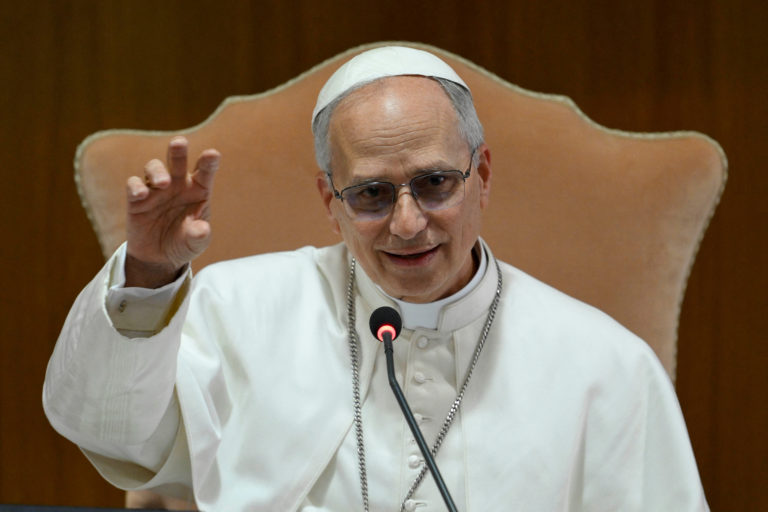
Pope Leo XIV is set to release a major manifesto on artificial intelligence (AI) on Monday, outlining the Catholic Church’s ethical response to the rapid global expansion of the technology.
The document, titled “Magnifica Humanitas” (Magnificent Humanity), will be presented at the Vatican in a landmark event, with the pope expected to attend in person alongside senior Holy See officials and leading technology experts.
Among the participants is the co-founder of US AI startup Anthropic, a company currently involved in a legal dispute with the US military over its policy restricting the use of its Claude model for lethal autonomous weapons and mass surveillance.
The Vatican said the encyclical aims to confront the social, ethical, and economic implications of AI, which is projected by the United Nations to reach a global market value of up to $4.8 trillion by 2033, while concentrating wealth among a small number of players.
Pope Leo, the first US-born pontiff, has repeatedly warned against the militarisation of AI, describing the delegation of life-and-death decisions to machines as a “destructive spiral.” He has also cautioned about the “gradual replacement of reality by its simulation” and raised concerns over environmental damage linked to the global race for rare earth minerals used in advanced electronics.
Experts say the forthcoming encyclical could have an impact comparable to Pope Francis’s 2015 climate document Laudato Si, which shaped global debate on environmental policy.
The Vatican described Magnifica Humanitas as an extension of Catholic social teaching focused on protecting human dignity in the digital age. It was signed on May 15, marking the anniversary of Pope Leo XIII’s 1891 encyclical that laid the foundations of modern Church social doctrine during the Industrial Revolution.
Observers say the Church is drawing parallels between past industrial transformation and today’s AI revolution, stressing the need for education, digital literacy, and ethical awareness in navigating emerging technologies.
Pope Leo has previously called for stronger safeguards against AI-driven “polarisation, conflict, fear, and violence,” and criticised the lack of transparency in algorithmic systems shaping global digital platforms.
The Vatican has been engaging with AI ethics in recent years, including the 2020 “Rome Call for AI Ethics,” which urged developers and governments to ensure new technologies respect human dignity.
His predecessor, Pope Francis, also consistently warned that unchecked AI development could deepen inequality and called for global regulation of the technology.