




By Ayomide Otitoju
Save the Children Nigeria has expressed confidence that sustained collaboration among the Kaduna State Government, development partners and local communities will help achieve the state’s target of returning 100,000 out-of-school children to the classroom.
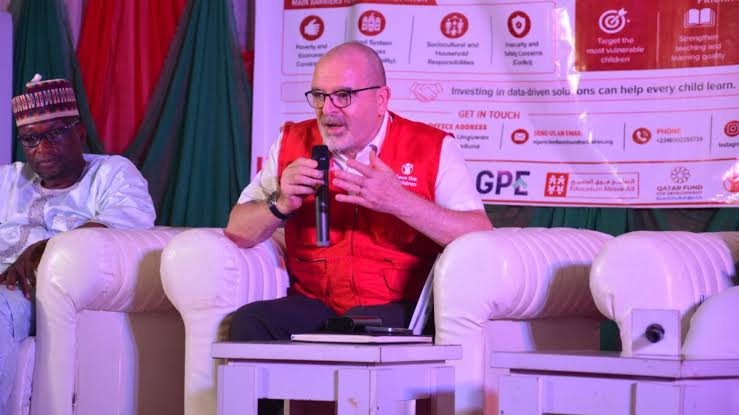
The Country Director of Save the Children Nigeria, Duncan Harvey, stated this during a press conference in Kaduna, where he outlined measures being implemented to ensure no child is left behind under the state’s education intervention programme.
Harvey reaffirmed the organisation’s commitment to delivering inclusive, community-driven and sustainable interventions aimed at improving access to education for vulnerable children.
He said the initiative is designed not only to enrol out-of-school children but also to ensure they remain in school, complete their education and encourage more children to attend school.
According to him, Save the Children is working closely with the Kaduna State Government, the United Nations Children’s Fund (UNICEF), the Project Management Unit and other development partners, with each organisation playing defined roles in the implementation of the programme.
Harvey explained that while some partners are responsible for constructing schools, classrooms and training teachers, Save the Children focuses on working with parents, communities and local authorities to address the barriers preventing children from enrolling in or remaining in school.
He noted that the Reaching Out-of-School Children (ROOSC) Project is being implemented in partnership with the Education Above All Foundation, Kuwait Fund, Qatar Fund for Development, the Islamic Development Bank and the Global Partnership for Education.
Harvey stressed that beyond providing school infrastructure, the success of the programme depends on ensuring that schools are safe, provide quality education and create a conducive learning environment capable of earning the confidence of parents and communities.
Also speaking, the Project Coordinator of the ROOSC Project, Ezra Angai, said the Kaduna State Government has intensified efforts to improve access to quality education through the construction of new schools, renovation of existing facilities and plans to recruit additional teachers.
Angai disclosed that 42 schools, including 16 new ones, are currently under construction, while learning centres and non-formal education institutions are being integrated into the programme to address the challenge of out-of-school children.
He said the project is currently being implemented across nine local government areas, with many of the construction projects already at advanced stages and expected to be completed by September.
According to him, procurement has also begun for the construction of 30 additional schools and the renovation of 60 existing schools, with the tender process expected to be concluded in the coming months.
The Director of Planning at the Kaduna State Ministry of Education, Salisu Lawal, acknowledged that teacher shortages remain a major challenge but said the government has completed a statewide teacher needs assessment to guide the recruitment of new teachers.
Lawal added that the recent extension of the retirement age for teachers from 60 to 65 years is aimed at retaining experienced educators to mentor newly recruited teachers while the recruitment process is completed.
He expressed optimism that the planned recruitment and ongoing education interventions would strengthen the state’s education system, improve learning outcomes and significantly reduce the number of out-of-school children.


