

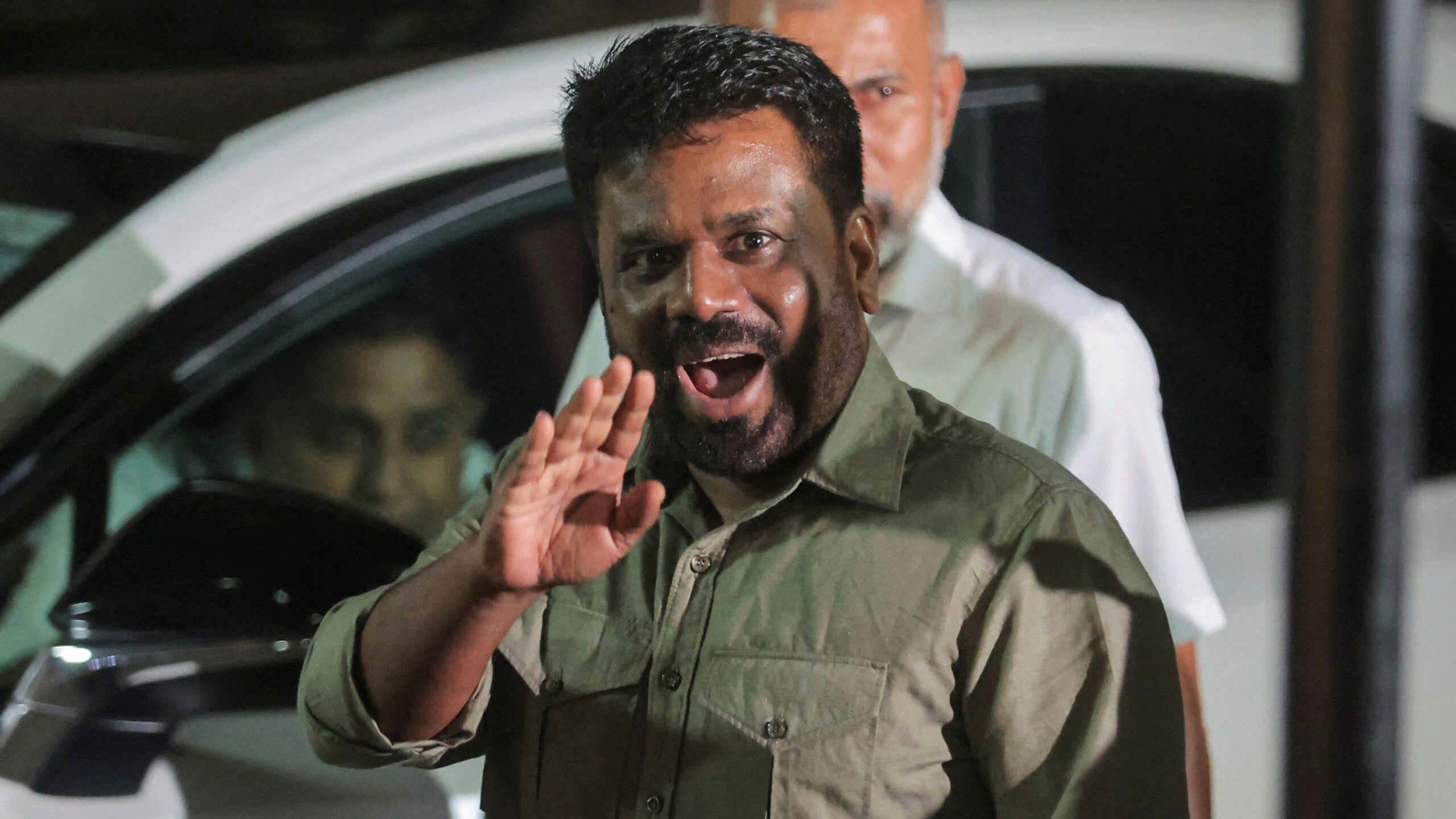
Anura Kumara Dissanayaka, Sri Lanka’s first leftist president, was sworn into office on Monday, pledging to restore public trust in politics after a sweeping victory in the polls. Dissanayaka, leader of the People’s Liberation Front (JVP) and a self-avowed Marxist, took his oath at the historic Presidential Secretariat in Colombo, following his decisive win on Saturday.
Once considered a fringe politician, Dissanayaka’s rise comes after the 2022 economic collapse, which plunged ordinary Sri Lankans into severe hardships. His JVP party, which led two failed uprisings decades ago, saw renewed support as citizens turned to alternative leadership in the wake of the financial crisis.
The 55-year-old president, sworn in by the chief justice, was joined by lawmakers, military officials, and members of the Buddhist clergy, who sang the national anthem after the ceremony.
“I will do my best to fully restore the people’s confidence in politicians,” Dissanayaka vowed. “I am not a conjurer, I am not a magician… but I will seek the best advice and do my best. For that, I need the support of everyone.”
Dissanayaka succeeds Ranil Wickremesinghe, who took office at the height of the crisis in 2022 after the country’s first-ever foreign debt default. Wickremesinghe, 75, implemented harsh austerity measures, including steep tax hikes as part of an International Monetary Fund (IMF) bailout, stabilizing the economy but leaving millions in hardship.
“I can confidently say that I did my best to stabilize the country during one of its darkest periods,” Wickremesinghe said, after placing a distant third in the election.
Before the inauguration, Prime Minister Dinesh Gunawardena resigned, paving the way for Dissanayaka to appoint his own cabinet. The new president’s party, however, holds only three seats in the 225-member parliament. A fresh parliamentary election is expected later this year.
Dissanayaka has committed to continuing the IMF bailout program but has signaled his intention to renegotiate its terms to deliver tax relief. “It is a binding document, but there is a provision to renegotiate,” said Bimal Ratnayake, a senior JVP official.
A Legacy of Rebellion
The JVP, under Dissanayaka’s leadership, has distanced itself from its violent past. The party’s two uprisings in the 1970s and 1980s left more than 80,000 people dead before it renounced violence. Though it had been a marginal political force since then, winning less than four percent of the vote in 2020, Sri Lanka’s financial meltdown has provided an opening for Dissanayaka, who has called for an end to the island’s “corrupt” political system.
The son of a laborer, Dissanayaka has remained grounded in his roots, having been a JVP student leader during the second insurrection. He has shared stories of surviving death squads by taking refuge with his teachers and continues to count Che Guevara as one of his heroes.
Despite his Marxist background, Dissanayaka has softened his policies in recent years, expressing support for an open economy and stating he is not wholly opposed to privatization, signaling a more pragmatic approach to governing.


