






By Ayomide Otitoju
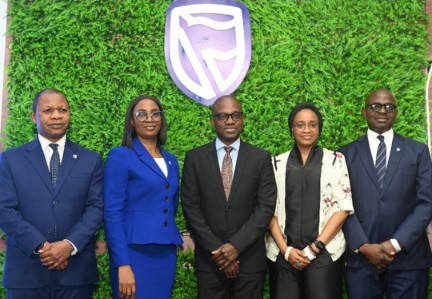
The Stanbic IBTC Holdings Sustainable Finance Summit 2.0, organised in partnership with the Lagos Business School Sustainability Centre (LBSSC), has concluded in Lagos with record participation and groundbreaking discussions on leveraging finance, digital innovation, and artificial intelligence (AI) to tackle climate challenges across Africa.
Themed “Financing Resilience: Digital Innovation and AI for Climate-Smart Communities,” the hybrid summit drew over 3,000 participants both at the Civic Centre, Victoria Island, and via YouTube livestream, with representation from financial institutions, regulators, academia, technology innovators, and international partners.
The event featured the unveiling of AI-powered climate risk assessment tools developed by Nigerian fintech companies, alongside robust panel discussions, technology demonstrations, and networking sessions. Participants explored how finance and technology can jointly drive sustainable solutions for Africa’s climate resilience.
Kunle Adedeji, Acting Chief Executive, Stanbic IBTC Holdings, hailed the summit as a validation of Nigeria’s potential in sustainable finance innovation. “This event has not only strengthened our position as industry leaders but also demonstrated the transformative power of collaboration between financial institutions, technology innovators, and policymakers,” he said.
Wole Adeniyi, Chief Executive of Stanbic IBTC Bank, highlighted the tangible benefits for participants, noting that professionals gained insights into deploying AI-driven ESG assessment tools, while technology startups secured funding discussions. Regulators also engaged in policy dialogues aligned with international best practices.
Bunmi Dayo-Olagunju, Deputy Chief Executive, Stanbic IBTC Bank, stressed the role of digitisation in climate risk management, noting that AI and machine learning enable predictive modelling for floods, droughts, and credit risks. She urged Nigeria to prioritise sustainable land use, climate education, and stronger adaptation policies.
From academia, Prof. Kemi Ogunyemi, of the Lagos Business School, emphasised the importance of industry-academic partnerships in driving climate-smart innovation, adding that the summit’s success underlined the potential of collective action.
In his keynote, Segun Ajayi, Country Director of Oracle Nigeria, called for stronger collaboration between governments, private sector, and technology providers to harness AI for a climate-resilient African economy. “With AI, Africa can transition from being perceived as high risk to being seen as high potential,” he said.
The summit reinforced Stanbic IBTC’s leadership in sustainable finance and demonstrated the growing role of digital innovation and AI in shaping climate-smart communities across Nigeria and the continent.