




By Atomide Otitoju
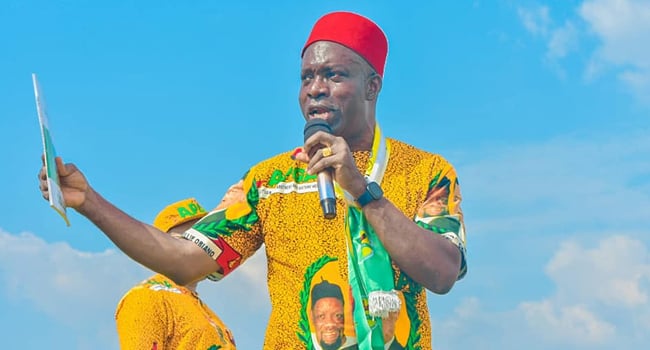
Governor Chukwuma Charles Soludo of the All Progressives Grand Alliance (APGA) has secured a second term in office after being declared the winner of the November 8 Anambra State governorship election by the Independent National Electoral Commission (INEC).
Announcing the results in the early hours of Sunday at the INEC headquarters in Awka, the State Returning Officer and Vice-Chancellor of the University of Benin, Prof. Omoregie Edoba, declared Soludo the winner after the collation of results from the 21 local government areas of the state.
“I hereby declare that Soludo Chukwuma Charles of the APGA, having satisfied the requirements of the law, is hereby declared the winner and returned elected,” Prof. Edoba said.
According to INEC, Soludo polled 422,664 votes, defeating his closest rival, Nicholas Ukachukwu of the All Progressives Congress (APC), who scored 99,445 votes. Paul Chukwuma of the Young Progressives Party (YPP) came third with 37,753 votes, while George Moghalu of the Labour Party (LP) and John Nwosu of the African Democratic Congress (ADC) garnered 10,576 and 8,208 votes respectively. Jude Ezenwafor of the Peoples Democratic Party (PDP) finished with 1,401 votes.
Sixteen political parties participated in the election, including the Allied People’s Movement (APM), African Action Congress (AAC), Action Alliance (AA), Accord Party (AP), New Nigeria Peoples Party (NNPP), Action Peoples Party (APP), Boot Party (BP), National Rescue Movement (NRM), Zenith Labour Party (ZLP), and Social Democratic Party (SDP).
Soludo’s victory, which extends APGA’s 19-year dominance in Anambra politics, grants him another four-year term at the Government House, Awka, lasting until 2030.
The 65-year-old former Central Bank of Nigeria (CBN) governor was first elected on November 10, 2021, winning in 19 of the 21 LGAs. His re-election marks the culmination of months of intense campaigning, during which he faced criticism over insecurity and economic challenges in the state. Soludo, however, pledged to consolidate on his first-term achievements and deepen developmental reforms.
Tight Security, Vote-Buying Allegations
Ahead of the election, the Nigeria Police Force deployed about 45,000 officers to ensure a peaceful process. Although the exercise was largely orderly, it was tainted by reports of low voter turnout and alleged vote-buying across several polling units.
Some candidates, including Soludo, decried the monetisation of the electoral process. Ukachukwu of the APC also condemned the practice, saying:
“If there’s no seller, there cannot be a buyer. Some people have chosen to sell their conscience, which is worse than those who buy votes. When you give up your right for money, you lose your voice as a citizen.”
The Economic and Financial Crimes Commission (EFCC) confirmed the arrest of three suspects for alleged vote-buying and said they would be charged in court.
However, INEC dismissed the allegations, insisting there was no concrete evidence.
“Vote-buying is a serious offence. If anyone has credible evidence, they should present it. We cannot act on mere allegations,” said Queen Agwu, the Resident Electoral Commissioner for Anambra, during an interview on Channels Television.
INEC also reaffirmed its commitment to transparency, confirming that election results were uploaded on the Result Viewing Portal (IReV).
Governor Soludo and his running mate, Onyeka Ibezim, are expected to receive their Certificates of Return from INEC in the coming days.


