







By Ayomide Otitoju
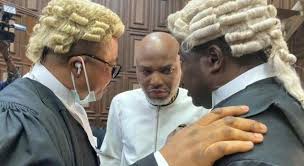
The trial of Nnamdi Kanu, leader of the proscribed Indigenous People of Biafra (IPOB), resumed on Tuesday at the Federal High Court in Abuja, with heightened security measures and significant legal maneuvering marking the proceedings.
ourt Grants Federal Government’s Request for Shielded Witnesses
Presiding judge Justice James Omotosho approved an application from the Federal Government to allow prosecution witnesses to testify behind screens, with their identities protected by pseudonyms. The move, requested by lead prosecutor Adegboyega Awomolo, SAN, was justified on grounds of security and the sensitive nature of the case. The defense, led by former Attorney-General Kanu Agabi, SAN, did not oppose the application[.
Defence Team Bolstered by Senior Advocates
At the hearing, the defense announced a 22-member legal team, though the judge limited the official roster to 13. Four additional senior advocates-Audu Nunghe, Joseph Akubo, Emeka Etiaba, and Onyechi Ikpeazu-joined the defense, reflecting the high-profile nature of the case.
First Prosecution Witness Testifies Behind Screen
The Federal Government opened its case with testimony from a Department of State Services (DSS) operative identified only as “AAA.” Testifying from behind a screen, AAA recounted leading the operation that resulted in Kanu’s arrest at the Golden Tulip Hotel near Lagos International Airport on October 14, 2015. According to the witness, hotel staff initially denied Kanu’s presence, but a subsequent search authorized by DSS leadership led to his apprehension. The witness described the room as resembling a broadcasting studio, equipped with various transmission devices. The items were seized and Kanu reportedly acknowledged ownership.
Video Evidence and Interrogation Played in Court
During the session, the court admitted and played a video recording of Kanu’s interrogation by DSS operatives, as well as documentary evidence related to the arrest. In his recorded statement, Kanu confirmed founding Radio Biafra and acknowledged he did not possess a Nigerian broadcasting license, stating he believed such an application would be denied. He insisted his activism was non-violent and rooted in the right to self-determination, referencing international human rights standards.
Trial Adjourned for Cross-Examination
Following the prosecution’s direct examination, the court adjourned the trial until Friday, when the defense is expected to cross-examine the DSS witness. The proceedings, which have drawn national and international attention, continue to serve as a focal point in debates over due process and the handling of separatist movements in Nigeria.
Background
Kanu, who has been in DSS custody since his extradition from Kenya in 2021, faces a seven-count charge including treasonable felony and terrorism. His arrest and ongoing detention have sparked significant protests and international scrutiny, with human rights groups calling for transparency and adherence to legal standards throughout the trial.