



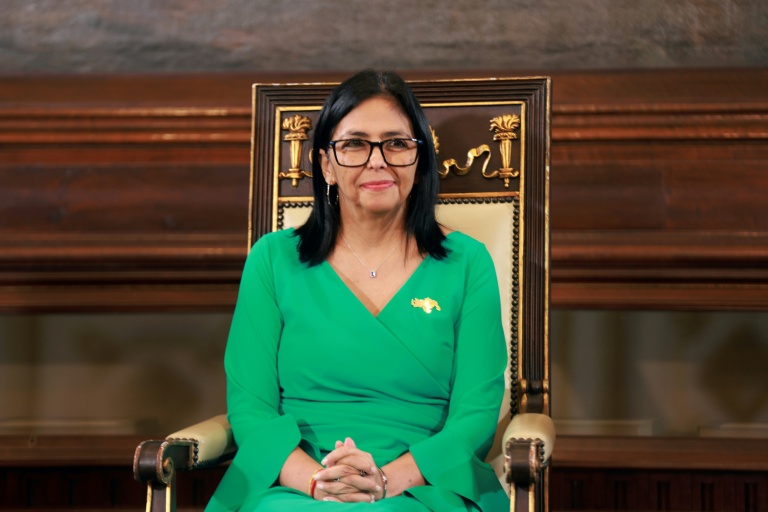
Venezuela’s interim president, Delcy Rodríguez, on Tuesday moved to consolidate control of government amid pressure from Washington to grant access to the country’s vast oil reserves, while also seeking to retain the loyalty of supporters of ousted leader Nicolás Maduro.
Rodríguez, 56, a former vice president, was sworn in as acting president on Monday, the same day Maduro appeared in a New York court, where he pleaded not guilty to charges of drug trafficking and “narco-terrorism.” His wife, Cilia Flores, who was captured alongside him during a US military operation in Caracas over the weekend, also entered a not-guilty plea.
The interim leader, whom US President Donald Trump has indicated a willingness to work with, faces a complex political balancing act. While signaling openness to cooperation with Washington—particularly on energy matters—Rodríguez has also sought to project unity with hardline figures from the Maduro era who retain control over the security forces and influential paramilitary groups.
On Monday, Rodríguez addressed the National Assembly, describing herself as “in pain over the kidnapping of our heroes, the hostages in the United States,” in reference to Maduro and Flores. The parliamentary session quickly evolved into a rally in support of Chavismo, the socialist and anti-US political movement founded by the late Hugo Chávez and continued by Maduro.
Meanwhile, Venezuela’s journalists’ union reported that 14 journalists and media workers, most of them representing foreign outlets, were detained while covering Rodríguez’s swearing-in ceremony at parliament on Monday and later released. Two other foreign journalists were also briefly detained near the Colombian border, according to the union.
Supporters of Maduro staged large demonstrations in Caracas on Monday, with further protests planned for Tuesday.
Opposition leader María Corina Machado, who has not been assigned a role in the post-Maduro transition by Washington, warned that Rodríguez should not be trusted. In an interview with Fox News, Machado accused the interim president of being deeply linked to corruption, repression and international criminal networks, and cautioned against international engagement with her administration.
Machado, a Nobel Peace Prize laureate currently outside Venezuela, said she intends to return “as soon as possible.” She also claimed that in free and fair elections, the opposition would win overwhelmingly, pledging to transform Venezuela into a major energy hub, dismantle criminal networks and encourage the return of millions of Venezuelans who fled the country.
The US administration has so far backed Rodríguez’s interim leadership but has warned of severe consequences if she fails to meet Washington’s expectations. Trump has publicly stated that Rodríguez would face “a very big price” if she does not comply.
Rodríguez has so far retained Maduro-era cabinet members, including Interior Minister Diosdado Cabello and Defence Minister Vladimir Padrino López, both widely viewed as wielding significant power behind the scenes.
Analysts have described the new administration as fragile. While some observers argue that internal rivalries could threaten Rodríguez’s position, others say the Chavista leadership understands that maintaining a façade of unity is essential to preserving power.
Rodríguez has been sworn in for an initial 90-day interim term, which parliament may extend once. Under Venezuela’s constitution, elections must be held within 30 days of Maduro being formally declared absent.