







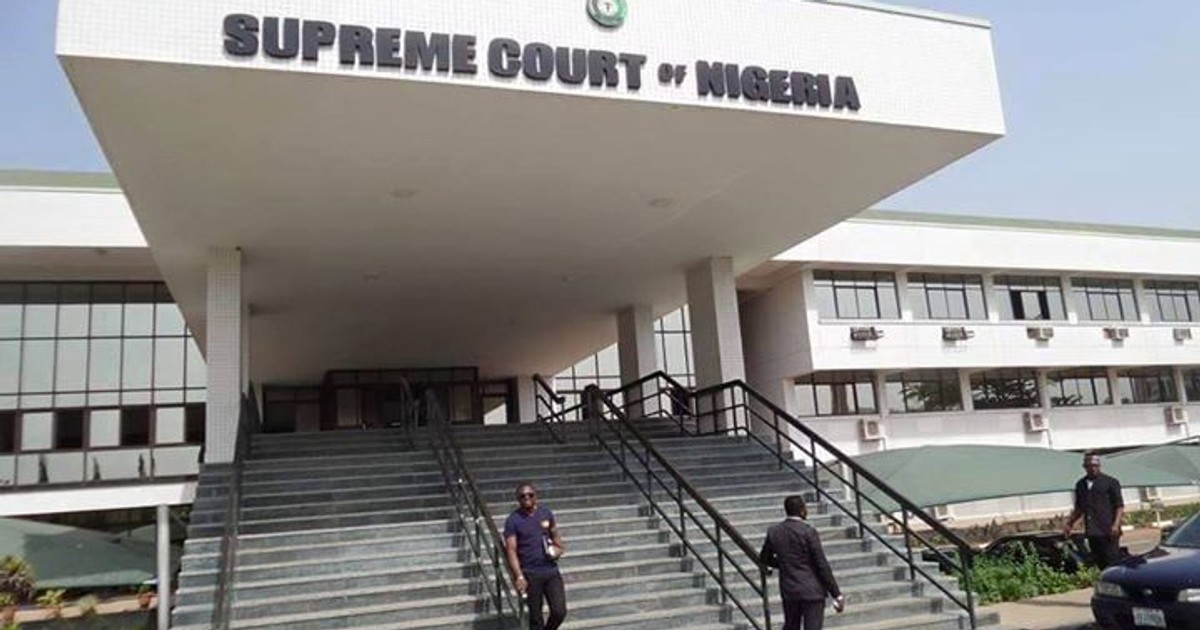
The Supreme Court has set October 22 to hear a suit filed by 16 state governments challenging the legality of the Economic and Financial Crimes Commission (EFCC) and the Nigerian Financial Intelligence Unit (NFIU).
The case, initiated by the Kogi State Government alongside 15 other states, questions the constitutionality of the laws establishing the EFCC and NFIU. A seven-member panel led by Justice Uwani Abba-Aji fixed the hearing date after granting the states’ requests to be joined as co-plaintiffs and consolidating the cases initially filed by Kogi State.
The states involved in the suit, marked SC/CV/178/2023, include Ondo, Edo, Oyo, Ogun, Nasarawa, Kebbi, Katsina, Sokoto, Jigawa, Enugu, Benue, Anambra, Plateau, Cross River, and Niger. When the case was called on Tuesday, counsel representing the states made their submissions, with the majority seeking to join as co-plaintiffs, while two states requested an order for case consolidation.
Kogi State Attorney General’s counsel, Abdulwahab Mohammed, explained that 13 states wished to be co-plaintiffs and only two requested consolidation. Justice Abba-Aji granted these prayers and adjourned the matter until October 22 for a full hearing.
The plaintiffs argue that the EFCC Establishment Act, which was based on a United Nations convention, was improperly enacted in 2004 without following the provisions of Section 12 of the Nigerian Constitution. They claim that the constitution mandates approval from a majority of state Houses of Assembly before any international convention can be incorporated into domestic law. Consequently, they argue that the EFCC and NFIU were unlawfully established and should be declared illegal.
Kogi State’s Attorney General sued the Attorney-General of the Federation as the sole defendant in the suit, raising six questions for determination and seeking nine reliefs. Among the reliefs is a declaration that the Federal Government and its agencies lack the authority to issue directives or manage funds belonging to Kogi State or its local governments. Additionally, they argue that the EFCC and NFIU have no legal standing to investigate or arrest anyone in relation to Kogi State’s financial administration.
The case is expected to have significant implications for the legality of federal anti-corruption bodies operating within Nigerian states


