





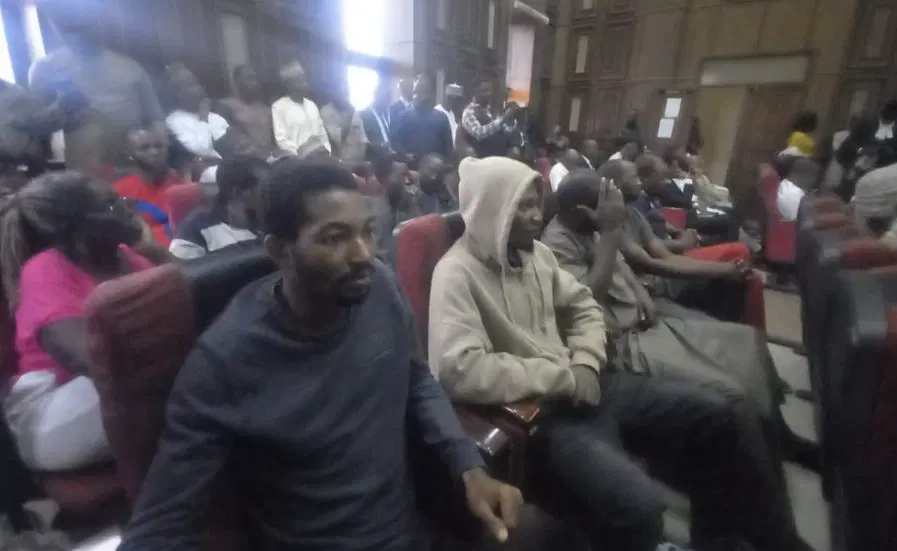
Justice Emeka Nwite of the Federal High Court in Abuja has ordered the remand of 10 protesters involved in the #EndBadGovernance demonstrations in prison custody. On Monday, the judge directed that nine male protesters be held at Kuje Prison, while a female protester was sent to Suleja Prison. The court has scheduled September 11 for the trial and ruling on the bail applications of the accused.
The protesters, arraigned on charges including treason, mutiny, and intent to destabilize Nigeria, include Michael Adaramoye, also known as Lenin, Adeyemi Abayomi, Suleiman Yakubu, Opaoluwa Simon, Angel Innocent, Buhari Lawal, Mosiu Sadiq, Bashir Bello, Nuradeen Khamis, and Abdulsalam Zubairu. All ten pleaded not guilty to the six counts of alleged treason, conspiracy to commit a felony, and incitement to mutiny—offenses punishable under Section 97 of the Penal Code.
The defendants are accused of plotting to levy war against the state, with the intent to intimidate President Bola Tinubu. The prosecution alleges that they attacked and injured police officers, and set fire to police stations, government buildings, and private properties during the protests.
Amnesty International Condemns the Trials
In response to the remand and upcoming trials, Amnesty International Nigeria expressed strong opposition. Isa Sanusi, the Director of Amnesty International Nigeria, criticized the trials as a sham, asserting that they are designed to punish those who exercise their right to peaceful protest.
“We condemn the sham trials even before they began and call for an end to these endless bizarre attempts to deprive people of the right to peaceful protest,” Sanusi said. “The Nigerian authorities must immediately and unconditionally release all those arrested from August 1 to 10 for exercising their right to peaceful assembly, instead of resorting to trumped-up charges just to justify unlawfully detaining them.”
Sanusi further condemned the Nigerian government’s focus on punishing protesters while failing to address the killings of demonstrators in various states, including Kano, Katsina, Suleja/Tafa, Jigawa, and Maiduguri. He highlighted reports of excessive force and misuse of tear gas by security personnel during the protests.
Backdrop of Economic Hardship
The #EndBadGovernance protests, which took place from August 1 to 10, were driven by widespread economic hardship and rising costs of living. Prices of food and basic commodities have soared in recent months, as Nigerians grapple with one of the country’s worst inflation rates and economic crises, exacerbated by the government’s removal of petrol subsidies and the unification of forex windows.
Organized primarily by youths and propagated on social media, the protests demanded the restoration of petrol subsidies, a return to the previous forex regime, and government action on food shortages, unemployment, and wasteful spending. Other demands included a reduction in the size of the President’s cabinet, a reduction in the cost of governance, and immediate reforms of the Independent National Electoral Commission (INEC) and the Economic and Financial Crimes Commission (EFCC) to intensify the fight against corruption.
The protests turned violent in several states, including Kano, Borno, Yobe, Kaduna, Jigawa, and Nasarawa, where hoodlums took advantage of the unrest to loot and destroy property. Police reported that seven people died during the protests, but denied that any were killed by security forces. Despite this, civil society organizations have condemned the actions of the police, particularly their use of tear gas to disperse protesters.


