

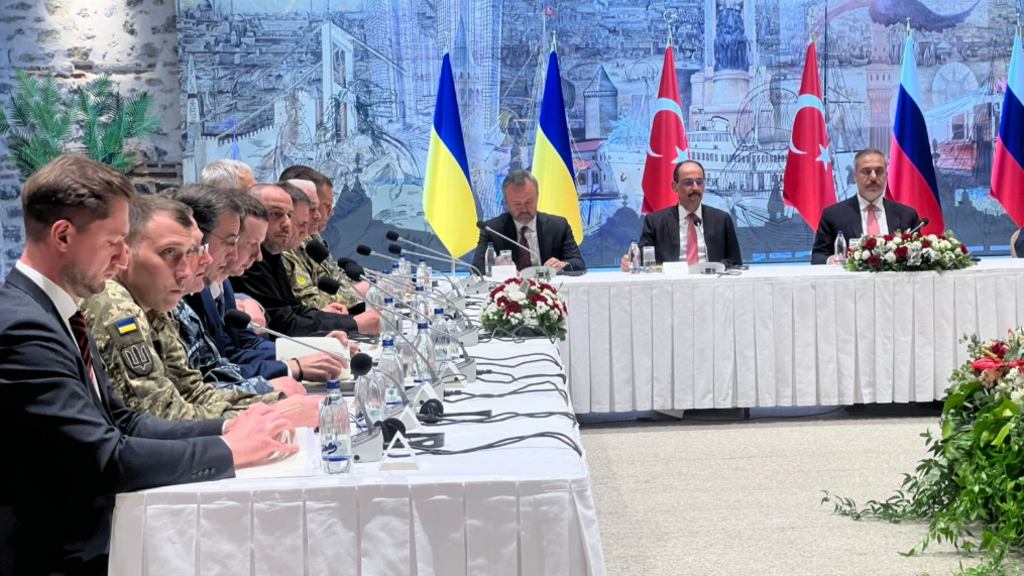
The first direct negotiations between Ukraine and Russia in over three years began Friday in Istanbul, offering a glimmer of diplomatic movement in a war that has claimed tens of thousands of lives and displaced millions across Eastern Europe.
Hosted at Istanbul’s historic Dolmabahce Palace, the talks were formally opened by Turkish Foreign Minister Hakan Fidan at 1:35 p.m. local time (1035 GMT). Delegations from both countries sat across from one another beneath their respective flags, with Fidan presiding over the session—symbolizing Ankara’s continued role as a regional mediator.
Despite the historic nature of the meeting, expectations for a breakthrough remain low. Kyiv has reiterated its demand for an “unconditional ceasefire,” while Moscow has signaled it intends to revisit the failed 2022 negotiation framework, which included broad territorial and political demands rejected by Ukraine.
Kyiv Demands Ceasefire, Russia Focuses on ‘Root Causes’
Ukrainian President Volodymyr Zelensky’s top adviser, Andriy Yermak, emphasized Kyiv’s priority: “Ukraine is ready for peace and a long-term and unconditional ceasefire. That is why our delegation is in Istanbul today.”
Russia, however, appeared focused on broader geopolitical aims. Vladimir Medinsky, who led the failed 2022 peace efforts, headed Moscow’s delegation again, despite criticism over his lack of seniority and decision-making power. “This is a continuation of the 2022 dialogue,” Medinsky stated, pushing back on accusations that the Kremlin was not serious. “Our team has a mandate from President Putin to find solutions and common ground.”
Absence of Putin Draws Criticism
President Vladimir Putin, who initially proposed the talks, declined to attend, opting instead to dispatch a lower-level delegation. Zelensky and several Western leaders condemned the move, seeing it as a lack of commitment to meaningful dialogue.
“Sending someone without authority is not a demonstration of seriousness,” Zelensky said, echoing sentiments shared by NATO Secretary-General Mark Rutte and EU foreign policy chief Kaja Kallas. “Putin’s absence makes clear Russia is not working toward peace,” Kallas remarked.
Intense Pre-Talk Rhetoric Undermines Atmosphere
The lead-up to the talks was marked by pointed exchanges between the two sides. In the 24 hours preceding the meeting, Kyiv and Moscow traded accusations, further casting doubt on the likelihood of rapid progress.
Ukrainian diplomats also held pre-meeting discussions with top Western officials, including U.S. Secretary of State Marco Rubio, Trump administration envoy Keith Kellogg, and national security advisers from France, Britain, and Germany. The United States, according to State Department spokesperson Tammy Bruce, remains committed to seeing the violence end and emphasized that “the killing must stop.”
A Ukrainian diplomatic source told AFP the delegation is also hoping to explore the possibility of a future Zelensky–Putin summit, though Russia has reportedly blocked U.S. participation in the current round of talks.
Fighting Rages as Talks Begin
Even as discussions commenced, Russia continued its military offensive, with Ukrainian officials reporting at least two civilian deaths on the day of the talks. Ukrainian Defence Minister Rustem Umerov, who is leading Kyiv’s delegation and hails from Russian-annexed Crimea, is expected to raise the continued violence as a central concern.
Russia’s territorial occupation now spans approximately 20% of Ukraine, with ongoing clashes dimming hopes for an immediate ceasefire.
Looking Ahead
While both sides remain far apart on core issues, observers say the mere resumption of dialogue represents a significant development in a protracted and deadly conflict. Whether these talks can evolve into meaningful negotiations—or simply offer a temporary diplomatic gesture—remains to be seen.
For now, the world watches Istanbul with cautious interest, as Europe’s deadliest war since World War II continues to exact a devastating toll.