




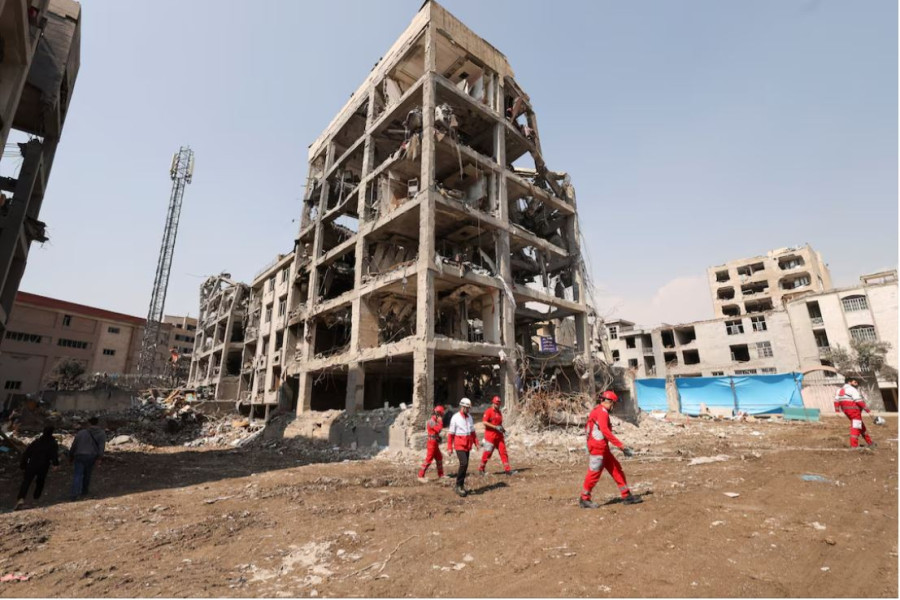
Israel launched a fresh wave of airstrikes against Iran on Monday, as Tehran threatened retaliation against vital infrastructure across the Middle East, intensifying a conflict that has triggered the worst energy crisis in decades. Explosions were reported in Tehran, while Saudi Arabia and the United Arab Emirates intercepted missiles and drones.
At least 40 energy assets in the oil- and gas-exporting region have been “severely or very severely damaged,” the International Energy Agency (IEA) said, as the war, sparked by Israel-US strikes on Iran, enters its fourth week. Tehran has responded by firing missiles and drones at Israel and Gulf targets, disrupting shipping through the Strait of Hormuz, a key route for one-fifth of global crude oil.
Oil prices remain above $100 per barrel amid supply concerns. US President Donald Trump warned that Iranian power plants could be “obliterated” if Tehran did not reopen the strait within 48 hours. Iran’s parliament speaker, Mohammad Bagher Ghalibaf, countered that vital infrastructure across the region would be legitimate targets if the threat was carried out.
IEA chief Fatih Birol said 11 million barrels of oil are lost daily due to the conflict—more than in the 1970s oil crises—and warned that no country would be immune to the effects if the crisis continues. “There is a need for global efforts,” Birol said. Asian stocks slipped while oil prices surged, with US crude briefly hitting $100 per barrel.
Israel has expanded its operations against Iran-allied Hezbollah in Lebanon, targeting bridges used to cross the Litani River. More than 1,000 people have died in Lebanon since the conflict escalated, with over one million displaced. Lebanese President Joseph Aoun condemned the attacks as a dangerous escalation, while Prime Minister Nawaf Salam blamed Hezbollah for initiating hostilities in retaliation for the killing of Iran’s supreme leader, Ali Khamenei.
Meanwhile, Israeli air defenses were breached by Iranian missiles that struck southern towns, including Dimona near Israel’s desert nuclear facility, injuring dozens. Israeli Prime Minister Benjamin Netanyahu vowed to target senior Iranian Revolutionary Guard commanders personally.
In Iran, at least 3,230 people have died in the conflict, including 1,406 civilians, according to the US-based Human Rights Activists News Agency. The full scale of casualties and damage remains difficult to verify independently due to restricted access to strike sites.
The conflict shows no sign of abating, with escalating attacks threatening both regional stability and the global energy supply.