





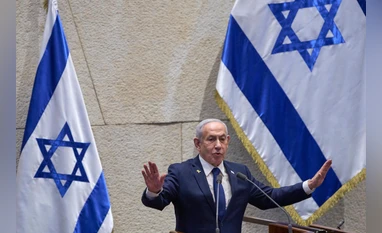
Israeli Prime Minister Benjamin Netanyahu, who is standing trial on multiple corruption charges, has submitted a formal request for a presidential pardon, saying the protracted proceedings are fuelling deep divisions within the country.
Netanyahu announced the move in a video statement on Sunday, emphasising that the six-year-long trial—expected to continue for years—has become “an impossible requirement” for a sitting prime minister. He maintained his innocence but said national stability must take priority.
“The continuation of the trial is tearing us apart from within,” Netanyahu said. “An immediate end to the trial will greatly help to lower the flames and promote the broad reconciliation that our country so desperately needs.”
His statement came weeks after former U.S. President Donald Trump wrote to Israeli President Isaac Herzog urging him to pardon Netanyahu. The prime minister’s request was accompanied by a 111-page letter from his legal team, which similarly did not include any admission of guilt.
Herzog’s office confirmed receipt of the application, noting that the request carries “significant implications” and will be considered carefully once all relevant opinions are reviewed.
Long-Running Corruption Case
Netanyahu and his wife, Sara, are accused in one case of receiving more than $260,000 worth of cigars, jewellery and champagne from wealthy businessmen in exchange for political favours. He also faces allegations of attempting to secure favourable media coverage from two Israeli outlets.
Netanyahu said the court’s demand that he testify three times a week had “tipped the scales,” describing the schedule as untenable given Israel’s current security climate.
Legal and Political Reactions
Israeli law experts noted that pardons can only be granted to convicted individuals. Professor Eli Salzberger of the University of Haifa described the timing of the request—shortly after Trump’s letter—as “an orchestrated move.” He added that if the pardon is rejected, Netanyahu may ultimately consider a plea bargain, an option he has previously dismissed.
Opposition leaders sharply criticised the move.
Yair Lapid insisted any pardon must require an admission of guilt, remorse and immediate withdrawal from political life.
Yair Golan of the Democrats party said, “Only the guilty seek pardon.”
Senior ministers, however, defended the prime minister.
Defence Minister Israel Katz said a pardon would help heal a “deep rift” in Israeli society, while Finance Minister Bezalel Smotrich accused the judiciary of persecuting Netanyahu.
Public Backlash
Protesters gathered outside Herzog’s home in Tel Aviv, urging the president to reject the request. Activist Shikma Bressler accused Netanyahu of attempting to “destroy the judicial system,” while another protester argued that granting a pardon could signal “the end of Israeli democracy.”
Netanyahu, 76, is Israel’s longest-serving prime minister and has vowed to run in the next elections due by 2026. His current term has been marked by high-profile clashes over judicial reform, which triggered mass demonstrations before the 2023 Gaza conflict shifted national focus.
Herzog’s decision is expected to take several weeks and could face a legal challenge, potentially prolonging the political and judicial crisis.