


By Ayomide Otitoju
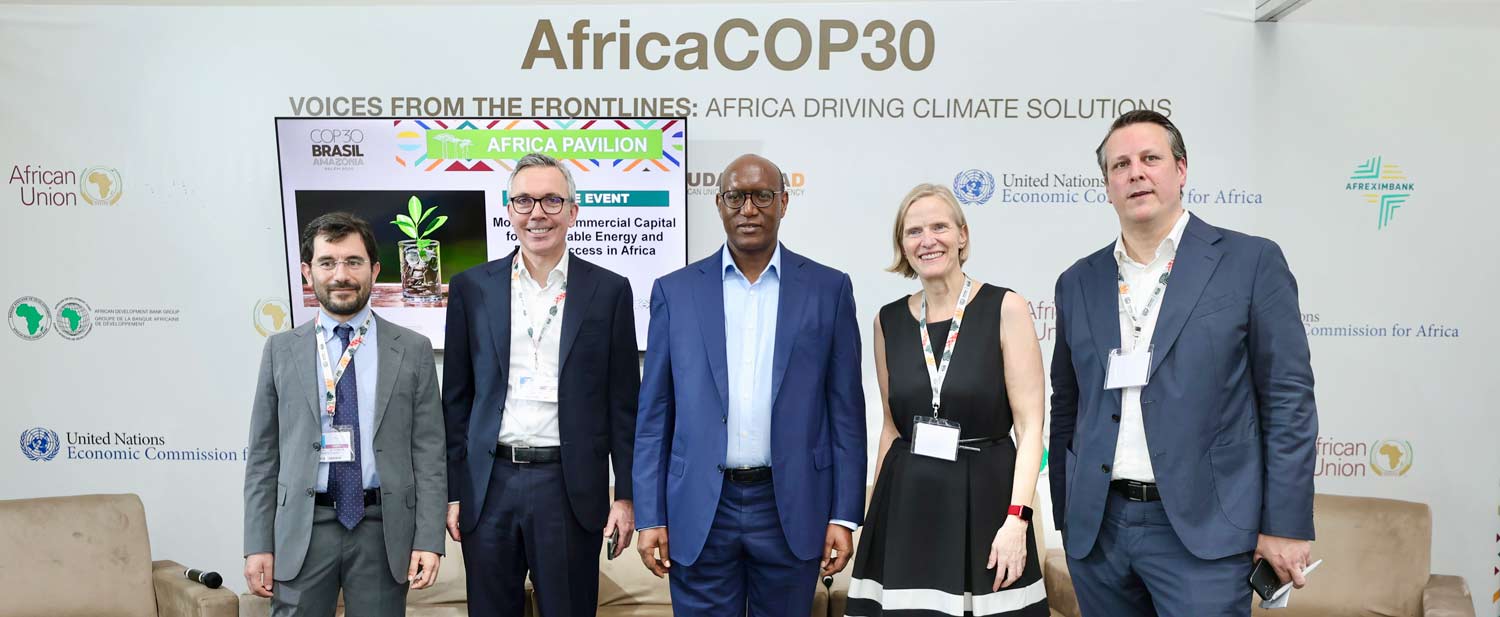
The African Development Bank Group’s Sustainable Energy Fund for Africa (SEFA) has secured new investment pledges totaling nearly €50 million to advance Mission 300 and accelerate climate action across Africa’s power sector. The commitments were announced at a COP30 side event held at the Africa Pavilion on 14 November.
Germany pledged €14 million to support SEFA’s universal energy access initiatives and €30 million for its green hydrogen programme, underscoring the sector’s strategic importance for Africa’s decarbonisation and industrial development. Italy contributed €5 million to the fund, reaffirming its commitment to Africa’s energy transition.
Dr Katharina Stasch, Director-General for Climate Policy at Germany’s Federal Ministry for Economic Cooperation and Development (BMZ), said, “By working together, we can create a ‘win–win’: African countries gain new energy resources, industrial development, technology transfer, and jobs, while Europe diversifies future energy imports. SEFA is a trusted partner in scaling Africa’s green hydrogen economy.”
Roberto Amerise, Director at Italy’s Ministry of the Environment and Energy Security, emphasized the need to mobilize private investment to accelerate Africa’s clean energy transition. “These resources reaffirm our collective commitment to advancing SEFA’s strategic objectives and implementing renewable energy and energy access projects across the continent,” he said.
Dr Kevin Kariuki, AfDB Vice-President for Power, Energy, Climate Change, and Green Growth, welcomed the new commitments, stating, “The support from Germany and Italy provides critical momentum for Mission 300 and reinforces SEFA’s central role in Africa’s universal energy access journey.”
Moderated by Dr Daniel Schroth, AfDB Director for Renewable Energy and Energy Efficiency, the event highlighted the importance of blended finance in de-risking projects and attracting commercial capital. Key projects discussed included Egypt’s Obelisk facility, a 1 GW solar PV and 200 MWh battery energy storage system co-financed by AfDB and SEFA, and SEFA-supported clean cooking initiatives by African company BURN, which are driving affordability and adoption at scale.
Speakers emphasized the need for predictable regulatory frameworks and human-centred, bankable projects to attract private investment. They also highlighted opportunities to leverage declining renewable energy costs to achieve the goals of Mission 300 and Africa’s broader climate objectives.
The event reinforced collective commitment to integrating energy transition initiatives into climate diplomacy, demonstrating that with coordinated investment and policy support, Africa’s renewable energy and universal energy access goals are within reach.


