








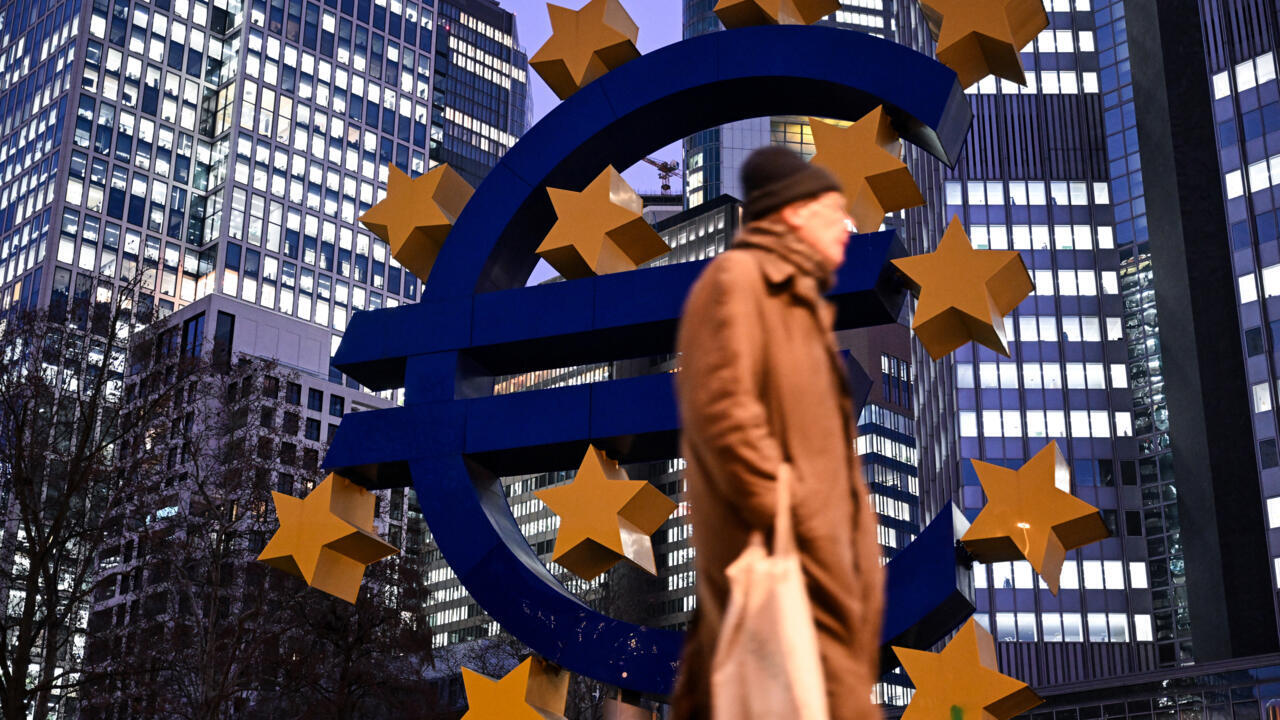
The European Central Bank (ECB) is expected to announce another interest rate cut on Thursday, but analysts suggest the bank may signal an upcoming pause in its easing cycle amid growing economic uncertainty.
The ECB has implemented six rate cuts since June last year, shifting focus from inflation control to supporting the struggling eurozone economy. The expected quarter-percentage-point reduction would bring the benchmark deposit rate to 2.5%, down from the record 4% reached in late 2023 after aggressive hikes to curb soaring energy and food prices following Russia’s invasion of Ukraine.
However, market watchers will closely scrutinize ECB President Christine Lagarde’s remarks for indications of a possible pause in further cuts. Some ECB officials have already suggested it is time to reassess the pace of monetary easing.
Uncertainty surrounding U.S. trade policy—particularly former President Donald Trump’s threats to impose a 25% tariff on EU goods—has added to concerns about economic stability. Additionally, Germany’s likely next chancellor, Friedrich Merz, announced plans on Tuesday to increase government spending by several hundred billion euros on defense and infrastructure, potentially influencing ECB policymakers.
Germany’s proposed spending surge is driven by fears of weakened U.S. security commitments to Europe and ongoing geopolitical instability. While the increased fiscal stimulus could boost eurozone growth, it also raises concerns about inflationary pressures, which might prompt the ECB to reconsider further rate cuts.
Investor expectations for an April rate cut have already diminished following Merz’s announcement, said Kathleen Brooks, research director at XTB. “If ECB officials view higher German spending as inflationary, we could see expectations for additional rate cuts scaled back,” she noted.
Growing Uncertainty in ECB Policy
Even before Germany’s spending pledge, ECB policymakers had begun questioning the need for continued rate cuts. ECB board member Isabel Schnabel recently told the Financial Times that the bank was approaching a point where it might need to pause.
“We can no longer say with confidence that our monetary policy remains restrictive,” Schnabel stated.
While eurozone inflation edged down to 2.4% in February, it remains above the ECB’s 2% target. Policymakers remain optimistic that inflation will stabilize at the target level later this year.
Meanwhile, in the U.S., the Federal Reserve recently paused its rate cuts due to rising inflation and uncertainty over Trump’s economic policies, adding another layer of complexity to global financial markets.
Lagarde has so far avoided committing to a long-term policy direction, maintaining a “meeting-by-meeting” approach. Analysts predict she will continue this cautious stance in her post-announcement remarks on Thursday.
“Global uncertainties have increased significantly in recent weeks,” said Felix Schmidt, an economist at Berenberg Bank, pointing to Trump’s tariff threats. “Given this, Lagarde will likely refrain from providing clear forward guidance, opting instead for maximum flexibility.”
The ECB will also release updated economic forecasts on Thursday, with inflation projections expected to remain stable. However, economists anticipate further downward revisions to eurozone growth expectations, reflecting continued economic weakness in Germany and France, which have lagged behind the U.S. and China.